Before we get started, its worth noting that the goal of the Hero Guides is not to tell you how to win at Sentinels of the Multiverse but instead to give you ideas to get the most out of heroes and help you become better at playing the game as quickly as possible. The truth is that if you keep playing and learning how heroes work, even without referencing a guide, you will see improvement in your play. The key is to understand a hero’s strengths and weaknesses so that you make good strategic decisions and give yourself the best chance to win each game. This initial Hero Guide only covers the Base Game of Sentinels of the Multiverse, if there is enough interest, I may publish updated versions that address the content in future expansions.
Intro – Legacy is one of the simplest and most straightforward heroes in Sentinels of the Multiverse to play which makes him a great choice for a new player. More importantly, he is a solid addition to nearly any team which we will discuss in further detail later on. Legacy’s backstory is something of a multi-generational Captain America and there’s little doubt that he makes a great leader for many superhero teams.

Hero Versions – There are two versions of Legacy in the Base Game. The first one is pictured above and is the better choice for a new player. Legacy’s starting health is pretty high so he can take some licks and keep fighting and his Galvanize power is easy to understand and very straightforward to use. Nearly every hero benefits from doing extra damage in Sentinels. You win by doing enough damage to the villain that you defeat them and simply put, Legacy helps other heroes accomplish this goal faster.
While this seems simple enough, consider other heroes that are damage dealers. Ra is a great example. Ra’s base power, Pyre, deals one target two damage. If you’re playing a four hero game (which seems to be the most balanced and is something I would recommend), Legacy is likely helping his teammates do at least 3 extra damage a turn, if each teammate is able to attack something. It can easily be more, if they attack more than once a turn as well.
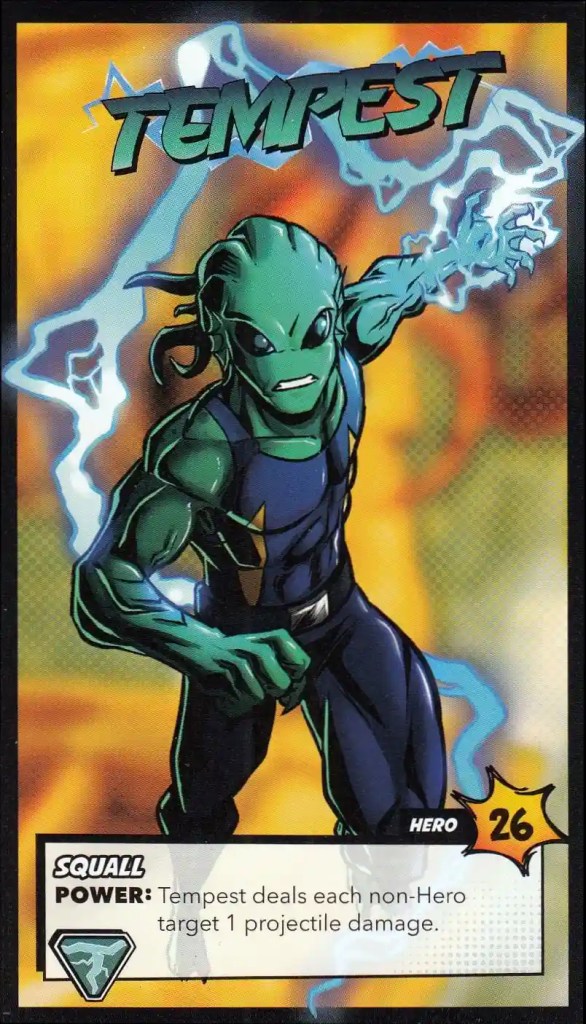
Additionally, if you have a hero like Tempest that tends to damage multiple targets, they really enjoy having Legacy on their team. The reason for this is that if Tempest would do 1 damage to three targets, that is obviously a total of three damage. However, with Legacy’s support, that is now six damage and that is much more formidable! In this way, Legacy really helps heroes that want to damage multiple targets at once which is something worth considering when you’re assembling your team.
One important rule to take note of is that Legacy himself does not do extra damage from Galvanize. It is only his allies that benefit. His First Appearance, pictured below, also does not directly benefit him because it boosts allies specifically.

Legacy’s First Appearance variant’s power is much more defensive and helps your heroes live longer. -1 damage is a powerful effect as well. If something only does one damage, its nullified by the Protector power. The ability can also come into play multiple times in a turn which really limits the villain’s ability to damage you. With that said, you do win the game by damaging your opponent and it can be argued that doing more damage is more useful for winning than preventing damage. That has been my experience anyway and I encourage you to experiment with the two versions to see which you think is stronger.
The one thing to keep in mind is that the Protector power can make some characters weaker. Fanatic and Absolute Zero are two great examples of this. Both of these heroes want to damage themselves to accomplish their own specific goals. Fanatic becomes way stronger if she gets to 10 Hit Points or lower, for example, and if Legacy prevents damage to her, she may not ever reach her full potential in a given game. So for this reason, Legacy’s First Appearance variant is not as good to give to new players, especially if you don’t select the right team to go with him. If someone takes this version of Legacy, they will likely make the game less fun for the person playing Absolute Zero or Fanatic and hurt your team’s chances of winning.
Deck Breakdown – Legacy’s deck can do several different things to support his team and so I’ve tried to break these up into categories to make them and the overall strategy of using this hero easier to understand. I’ve also ranked them in terms of their usefulness in a game. So the ones at the top of the list are the most powerful and useful and the ones near the bottom are either less useful or are more situational, which means they are less likely to be useful unless very specific things occur. The six categories are:
- Ally damage boost
- Direct damage
- Ally buffs
- Additional powers
- Tank effects
- Villain deck disruption

So the first category, Damage boost, is a really straightforward one. It consists of one card, Inspiring Presence, which is pretty powerful. It gives allies the ability to do +1 damage which stacks with the base version of Legacy, giving you +2 damage. Since I already explained how powerful this can be, I won’t belabor the point any further. Inspiring Presence also can heal allies 1 Hit Point which is a nice side bonus as well. Unless you know the villain is going to remove it quickly, you already have one in-play, or your allies won’t be attacking much in the current turn, Inspiring Presence is pretty much a must play card.

Direct damage, is easy to understand and use in Legacy’s deck. Each of these cards let you directly attack a villain, minion, or environmental target. Legacy is actually fairly strong for a support hero in this area and can do a surprising amount of damage if you draw many of these cards in a game. The most powerful is most likely Thokk! which lets you hit someone for five damage. Flying Smash is a great play whenever you have multiple targets on the board as the potential to deal nine damage total is a quite a lot. The final card, the Ol’ One-Two is less powerful but lets you play another card (if you have one, Legacy often has fairly small hands since his card draw is limited) and do two damage which is not bad either. In my opinion, the direct damage cards are satisfying to use and generally a great play on any given turn. You can rarely go wrong damaging dangerous minions or the villain and so you’ll probably find yourself using these cards pretty often with Legacy.
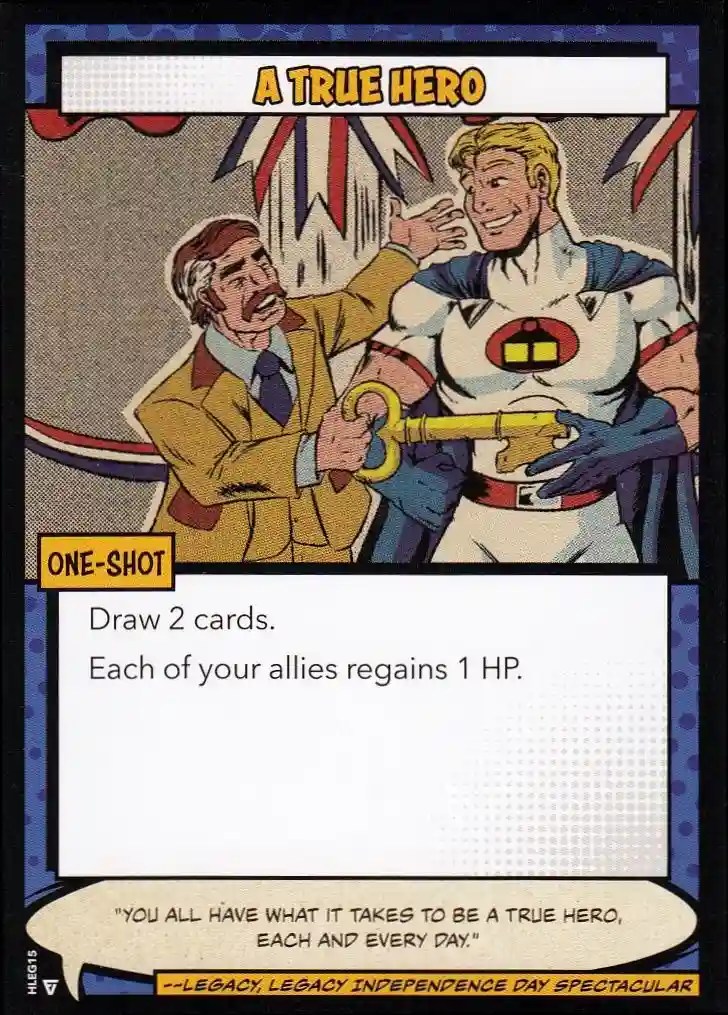
Next, we have ally buffs which consists of healing and card draw. Bolster allies allows every hero to draw a card and one of your allies can play a free card which can be quite nice, especially early in the game. A True Hero lets you draw two cards which is the most potent card draw in Legacy’s deck and heal your allies 1 Hit Point. These cards can be helpful but they’re situational. If your allies are struggling to get their decks going, drawing extra cards really helps. Healing tends to be more useful mid to late game as you can only restore lost Hit Points and you can never go above your starting HP.

You might be surprised to see the next category not rated higher but the truth is that Legacy’s default power (no matter which version of the hero you use) is his best. The Legacy Ring is quite possibly the most deceptive card in Legacy’s deck. The ability to use two powers in a turn sounds, well, incredibly powerful, but is it? Let’s examine what secondary powers you can use.
Danger sense is a slow way to get rid of nasty environment cards and if the villain can destroy ongoing cards, its vulnerable to disruption as well. You have to play the card and then use a Power to get rid of both Danger Sense and the environment card. There are other heroes that can do this more efficiently so this card is situational at best and not one that I play often.
Keen Vision lets you reveal the top card of a single deck. It can either be drawn or the person who drew it can use a power. As card draw, this isn’t all that strong but being able to use a power could be handy if an ally has multiple powers on the board and won’t be able to use them all in a given turn. Remember that you can’t use a card like Keen Vision to repeat a power in a given turn, unfortunately.

And finally, I saved the best for last, Motivational Charge is the best all around additional power. It does 3 damage and lets your ally heal 1 Hit Point. This is pretty much always useful as a second power and lets Legacy become a bit more of a damage dealer instead of a support hero.
The challenge with this is that its hard to get The Legacy Ring and Motivational Charge out at the same time because Legacy’s card draw is not that strong. If you can pull off this combo and keep it going, Legacy can boost allies with his main power and deal out damage of his own so its certainly worth going for when the opportunity presents itself.
As a leader, Legacy can wield some tank cards in battle which range in effectiveness. This means that he can either prevent damage to teammates or take damage to protect more vulnerable heroes. The most versatile one is Bulletproof Skin which gives you -1 damage to Legacy. This is pretty much always a good card to play as Legacy has almost no other way to reduce damage that is dealt to him.
Lead From The Front lets you redirect damage to Legacy which can build off of Bulletproof Skin nicely. If you have lower Hit Point heroes on your team, then Lead From The Front becomes even more useful. However, if you’re already using heroes that have some decent defensive cards, like Wraith or Haka, then it is not worth playing as they already have the -1 damage boost.
Dauntless Durability is probably the least effective tank card because it is an ongoing that only activates if Legacy is dealt five or more damage. That is incredibly rare in the base game and so this card is very unlikely to impact the game. Instead, it will sit around waiting to be used and is more likely to be destroyed by the villain when you could have played something else instead.
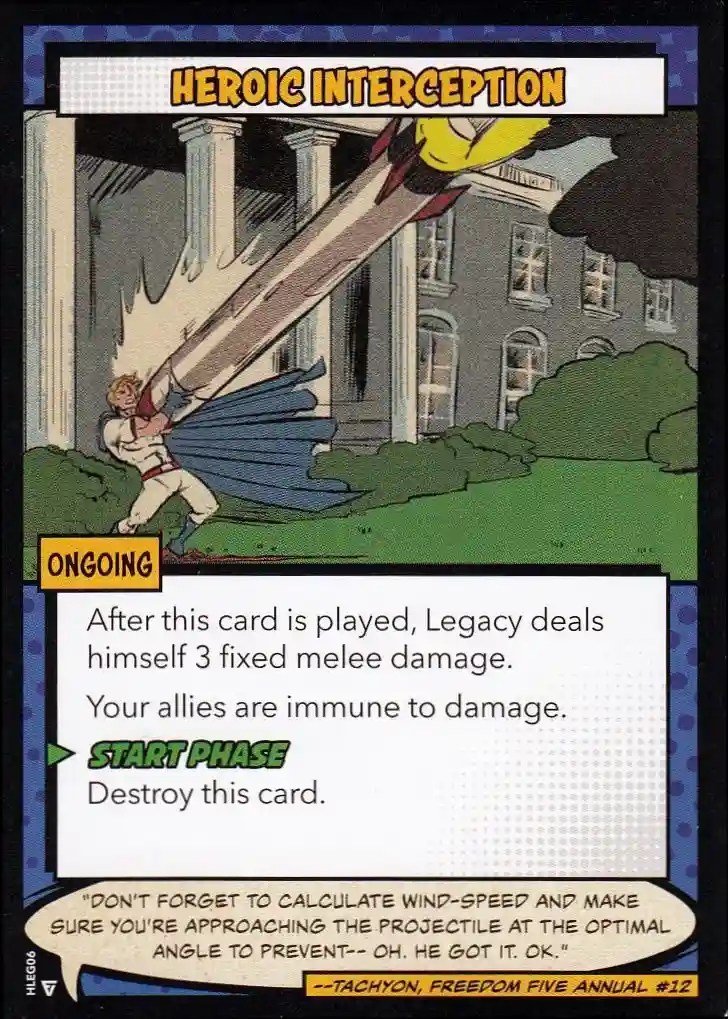
Heroic Interception prevents all damage done to allies in a turn in exchange for 3 damage done to Legacy. This can be quite useful, particularly if you know that the villain is about to hit you for a lot of damage next turn.
The combination of Bulletproof Skin and Lead From The Front can be useful depending on what heroes you select but its not easy to get and keep the combo on the board at the same time. Legacy can do a bit of tanking but generally speaking, it doesn’t have a huge impact on whether you win or lose a game and so that is why these cards tend not to be as useful as the ones we’ve previously discussed.
And finally, we have Villain deck disruption which consists of a single card. Takedown is an ongoing that lets you essentially cancel a villain card as it is played at the cost of two damage to Legacy. This is not a bad tradeoff as most villain decks do have some cards that can make winning noticeably harder. The catch is that you need this card to be in play before that card is revealed which means that this card could be destroyed before that happens or that Takedown sits on the table and never becomes useful. Takedown can be really useful or it can do nothing for you. If you have experience with the villain you’re facing off against, that can help you decide whether this card is potentially useful to you or not but generally speaking its high risk and low reward with an infrequent payoff.
Strengths and Weaknesses – Legacy is a pretty straightforward Support hero in that his best power is pretty easy to figure out and there isn’t a lot of choice or complexity for him in the Power Phase. Your allies will be glad that you’re helping them do extra damage or receive less damage as well. Since its pretty straightforward to figure out what power or powers to use on your turn, the main decision point for this hero is what card to play each turn. Even that is not especially hard to figure out if you can determine what is most likely to help you win the game at any given point.
Legacy is good at boosting allies and dealing some direct damage (assuming you draw those cards). You can dabble in other things like tanking or trying to use two powers a turn depending on what you draw from there. Legacy does not have great card draw and so you have limited control at times in what you can play. When you combine this and the lack of decision-making with his powers, more experienced players might find Legacy to be a bit boring to play. However, he is reliable and you rarely regret bringing the base version of Legacy, in my experience. If you really want to see how powerful Galvanize can be, try pairing the base version of Legacy with damage dealers like Ra, Fanatic, Wraith, or Tempest and watch your villain melt under your allies’ furious attacks!
That brings us to the end of Legacy’s Hero Guide. If you have any tips for playing this hero or think I got anything wrong, we’d love to hear your thoughts in the comments below!
 Kuribo's Painting
I would say that is pretty comprehensive Jeff, and covers all the positives and negatives from this character.
LikeLiked by 1 person
Thank you, Dave. It became more comprehensive than I originally intended which probably means I’ve set the bar high for myself here.
LikeLiked by 1 person
I don’t know what this is so obviously uncool middle aged dudes aren’t the target audience. 😀
should be helpful to someone cooler than me.
LikeLiked by 2 people
It has nothing to do with coolness and more to do with you not being a board/card gamer, I reckon 🙂 And of course, there’s no shame in that either. Hopefully some people out there find it useful or enjoy reading it. We shall see!
LikeLike
I enjoy Sentinels of the Multiverse, +1 audience here
LikeLiked by 1 person
Glad to hear it and to have you aboard!
LikeLike