Before we get started, its worth noting that the goal of the Hero Guides is not to tell you how to win at Sentinels of the Multiverse but instead to give you ideas to get the most out of heroes and help you become better at playing the game as quickly as possible. The truth is that if you keep playing and learning how heroes work, even without referencing a guide, you will see improvement in your play. The key is to understand a hero’s strengths and weaknesses so that you make good strategic decisions and give yourself the best chance to win each game. This initial Hero Guide only covers the Base Game of Sentinels of the Multiverse, if there is enough interest, I may publish updated versions that address the content in future expansions.
Intro – Not unlike the previously covered Legacy, Ra is a fairly straightforward hero that is a quintessential representation of the damage dealer hero type in Sentinels of Multiverse. If you’ve played Magic: The Gathering, this deck is reminiscent of Red decks that use direct damage to defeat their opponent. Ra’s backstory reads something like a mix of Thor and Moon Knight. Blake Washington found a relic in Egypt and was turned into the fire-wielding, god-like being known as Ra. If you choose to play this hero, you two will have the ability to sling fire at your opponents and be a key part in taking down whichever villain you’re facing. Best of all, Ra is fairly easy to do well with and is most certainly new player friendly but is also a bit more lively to play than Legacy at the same time.
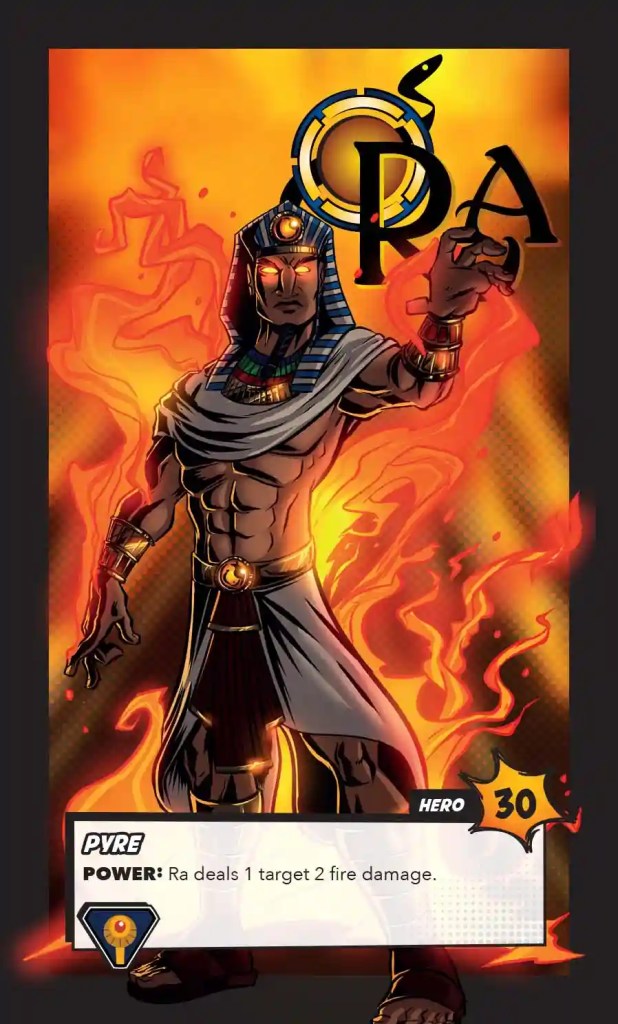
Hero Versions – In the Base Game, there are two versions of Ra. The base version, which is pictured above, is very easy to understand. Ra has 30 health which is neither high nor low and his power, Pyre, allows you to do two damage per turn. Obviously, this offers a steady amount of damage each turn which is almost always useful in Sentinels as you have to do enough damage to defeat the villain. While two damage isn’t a crazy amount, its nice to have this option every turn of the game and it can be boosted by Staff of Ra which we will discuss in a bit. If you’re relatively new to Ra or Sentinels, this is the version to go with. It is much more straightforward to use than the other version of Ra which we will examine next.
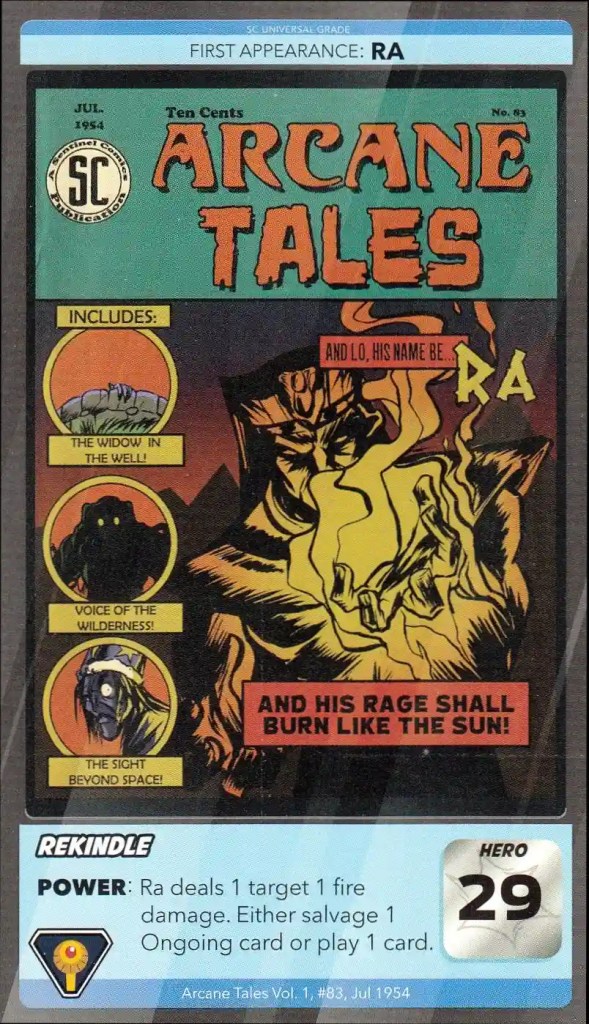
The First Appearance version of Ra has one less hit point and does one less damage per activation as well. The big difference is that you can either salvage an Ongoing card or play an extra card in your hand as well. We will breakdown the cards in Ra’s deck shortly, but I will attempt to describe what advantages this gives the player at a high-level for now. If you find this next section confusing, try skipping ahead to the Deck Breakdown below and then revisiting this portion of the guide.
The first option Rekindle offers is to salvage an Ongoing card per turn, but how useful is this? Part of the answer depends on how much Ongoing card destruction there is in the Environment and Villain deck. If there is a decent amount, then it can be nice to go back and grab an Ongoing card that was previously removed. However, with the exception of Ignite, there are very few “must play” Ongoing cards in Ra’s deck. Most of the Ongoing either offer some defensive abilities, boost your damage, or can do mass damage (meaning hit several targets for a little bit of damage instead of one target for a larger amount of damage). Mass damage and defensive abilities are not Ra’s strengths overall however so the ability to salvage Ongoing cards is limited in its usefulness.
There are two other downsides to salvaging Ongoing cards. The first is that you need to draw Ongoing cards to be able to salvage them. I have used First Appearance Ra before and drawn almost no Ongoing cards in the game (and the ones I did draw never got discarded as well) which makes this part of the power nearly worthless. Its also worth keeping in mind that, generally, salvaging destroyed or discarded cards is not necessarily moving forwards in terms of winning the game. We want to play powerful cards and build up our heroes, not just try and recover what has been lost or destroyed but that is essentially what Rekindle offers.
That is a nice transition into the other option which is to play an extra card with Rekindle. This is definitely more powerful than recovering an Ongoing card but again, it is not quite as good as it sounds. Ra does not have very much card draw and so if you’re playing an extra card per turn, you’re going to empty your hand in no time. As we’ll discuss in the Deck Breakdown section, Ra has some really powerful cards and some pretty situational cards so the advantage you gain by playing extra cards may seem great but it quickly diminishes after a couple of turns.
All this is to say, I find the base version of Ra to be much more steady and reliable. There are interesting things you can use First Appearance Ra to do but there is definitely an element of luck involved because it is draw dependent. If you have allies that help Ra draw cards, The First Appearance version might be the more powerful version of the two but it helps to be pretty knowledgeable with the hero before you dabble with this version.
Deck Breakdown – Ra has a number of loose categories that I will group cards into and then rank from most useful to least useful/most situational.
- Staff of Ra
- Direct Damage One-Shots
- Ignite
- Mass Damage and Damage Boosting Ongoing Cards
- Defensive Ongoing Cards
- Environmental Cards
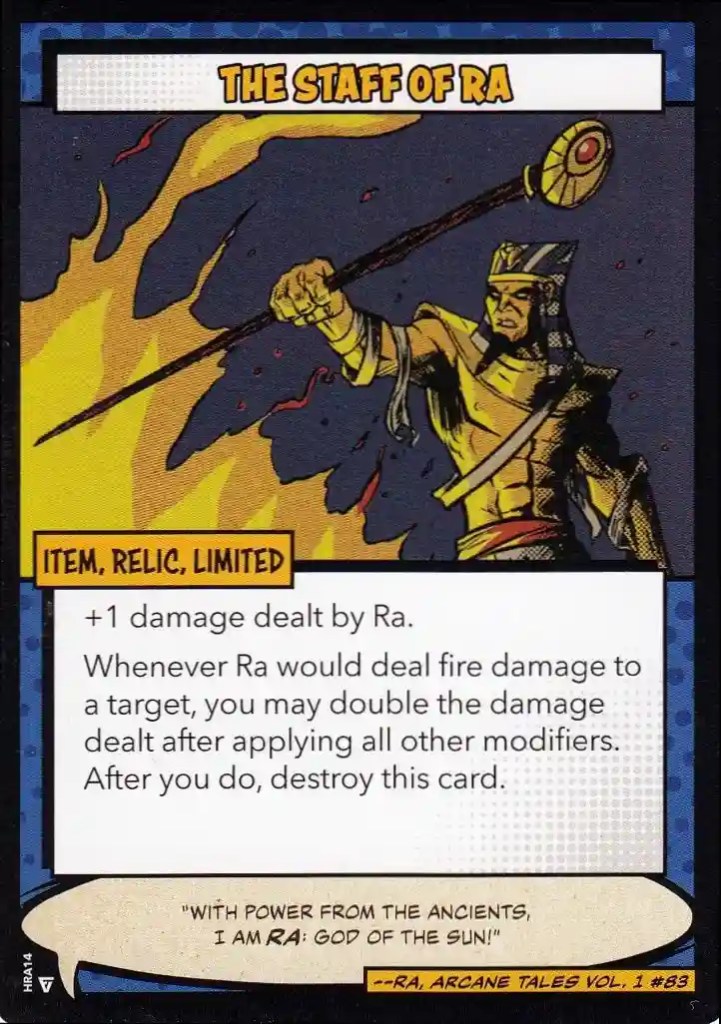
Staff of Ra – The Staff of Ra is a fairly obvious must play card though there is some nuance to it at the same time. The +1 damage bonus is always useful. It lets Ra do even more damage and it makes quite a few cards in the deck much more potent. Its worth noting that this bonus can be stacked with Legacy’s Galvanize power to really carve up your opponents.
The nuance is with the second part of the card which lets you destroy the Staff and double your damage after applying modifiers. This makes a card like Fire Blast do enormous amounts of damage for a reasonable cost. Its not that hard to deal 12, 14, or even 18 damage with the right combination of cards (Fire Blast + Staff of Ra + Legacy’s Galvanize power + Solar Flare).
The trick is sacrificing Staff of Ra in the right circumstances. There are three copies of it in your deck and there is also By Flame Reforged! which can go and get you a copy of Staff of Ra and put it into play. That means you can discard Staff of Ra a couple times in a game potentially and double your damage in a big way. You always want to pair Staff of Ra’s ability with a high damage card like Fire Blast but don’t feel like you need to play overly conservatively with Staff of Ra either. Its a mistake I made as a newer player until I realized that Staff of Ra can easily be played 3-4 times in a game if you have good card draws.
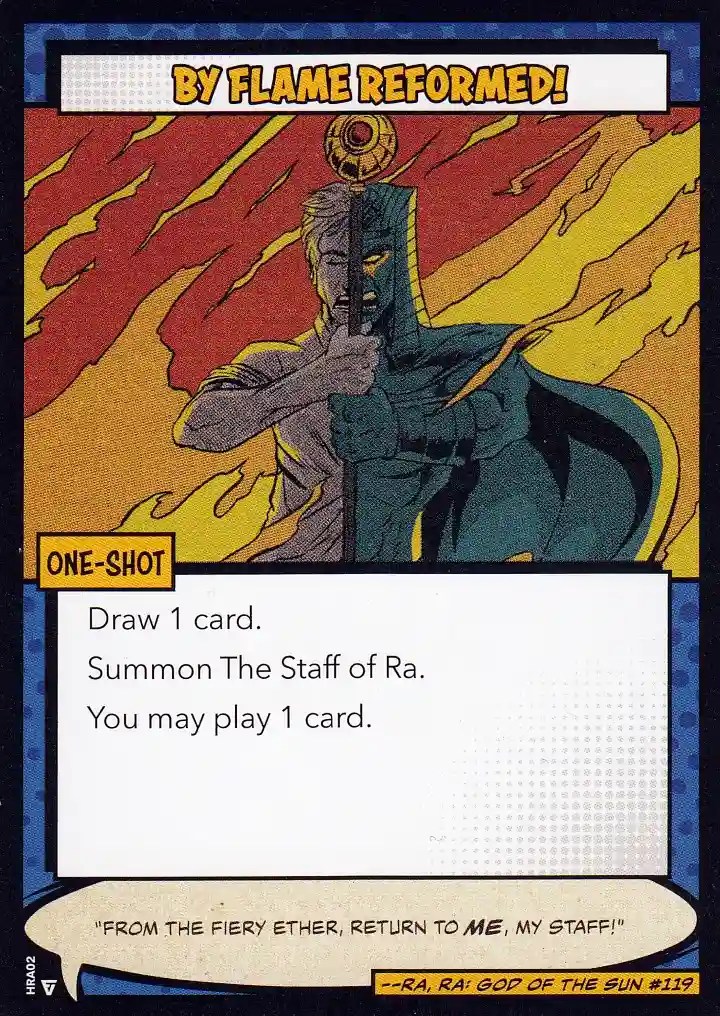
It already got a quick mention but By Flame Reformed! is a must play card if you don’t have Staff of Ra in play yet. It will go and get you a copy and put it into play, allow you to draw a card, and play another card. That is really powerful, especially in a deck with minimal card draw. If I have a Staff of Ra in hand and a copy of By Flame Reforged!, I’ll play By Flame Reforged! because it offers more benefits/utility than playing Staff of Ra on its own.
The more mileage you get out of these two cards, the better you’ll do with Ra and that’s why I consider them to be the most important in this deck.

Direct Damage One-Shots – Another important set of cards are the One-Shots that let you deal damage to your opponents. I already referenced Fire Blast which is the strongest card and should be paired with sacrificing Staff of Ra whenever you can.
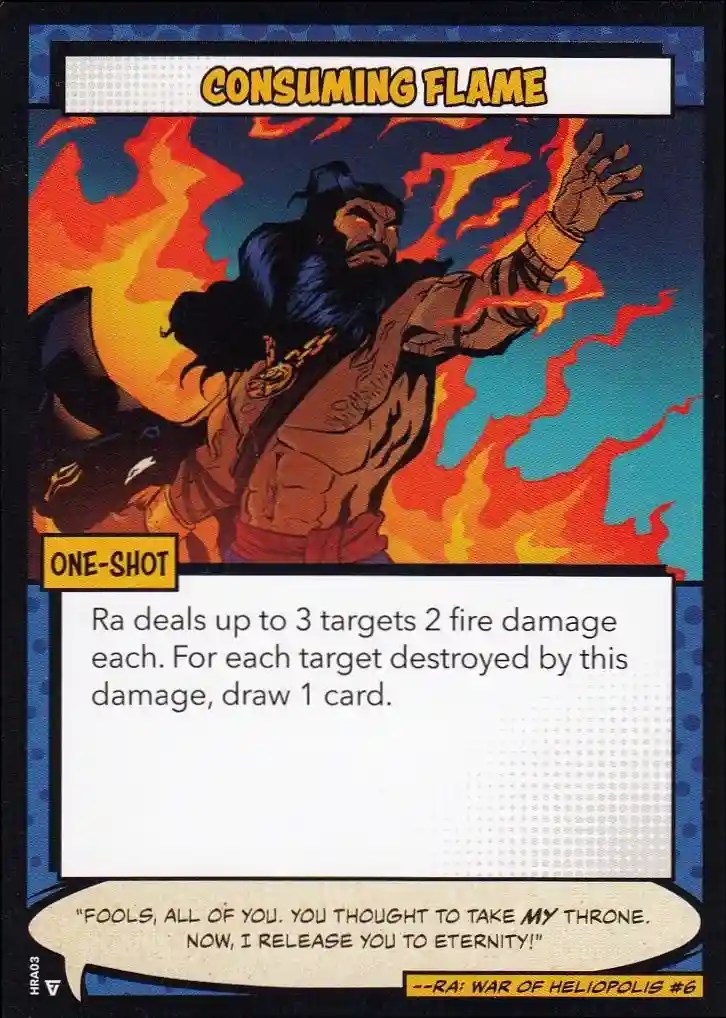
Consuming Flame really benefits from Staff of Ra and Legacy’s Galvanize power to do mass damage. Of course, if you can destroy any targets, getting to draw some cards is really nice too.
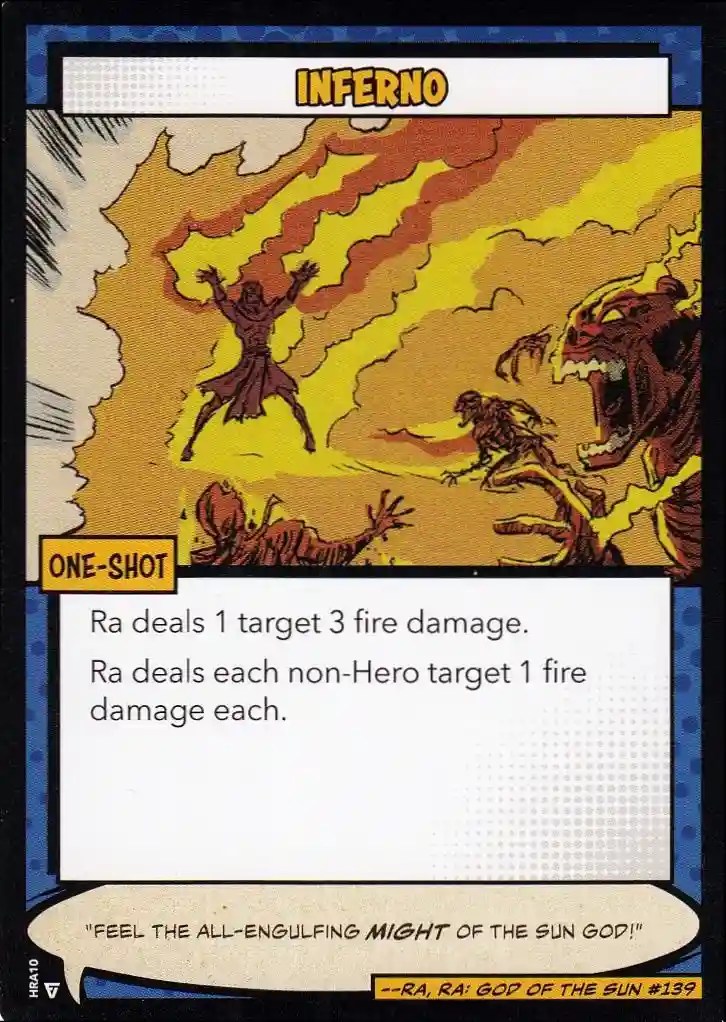
Inferno isn’t quite as powerful but it does combine single target and mass damage into one card which is pretty nice.
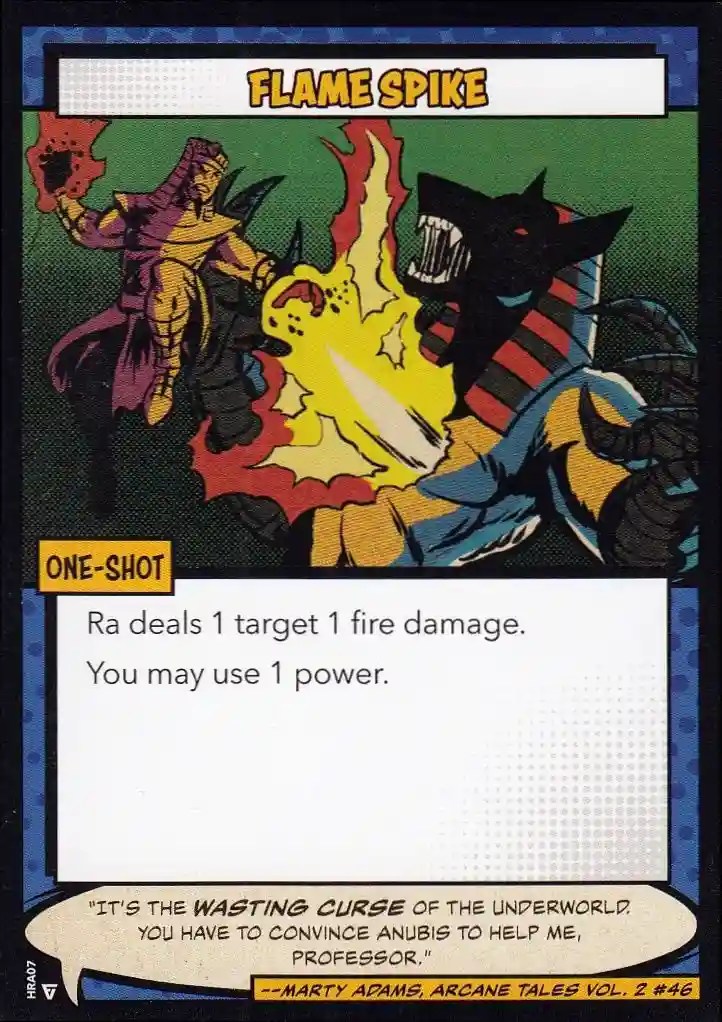
The only one of these cards that is pretty situational is Flame Spike. It only does one damage and lets you play an extra power. In most cases, this is likely Ra’s main power and Ignite, so this card is pretty underwhelming and is one that is likely to sit in your hand for a long time or become discard fodder.
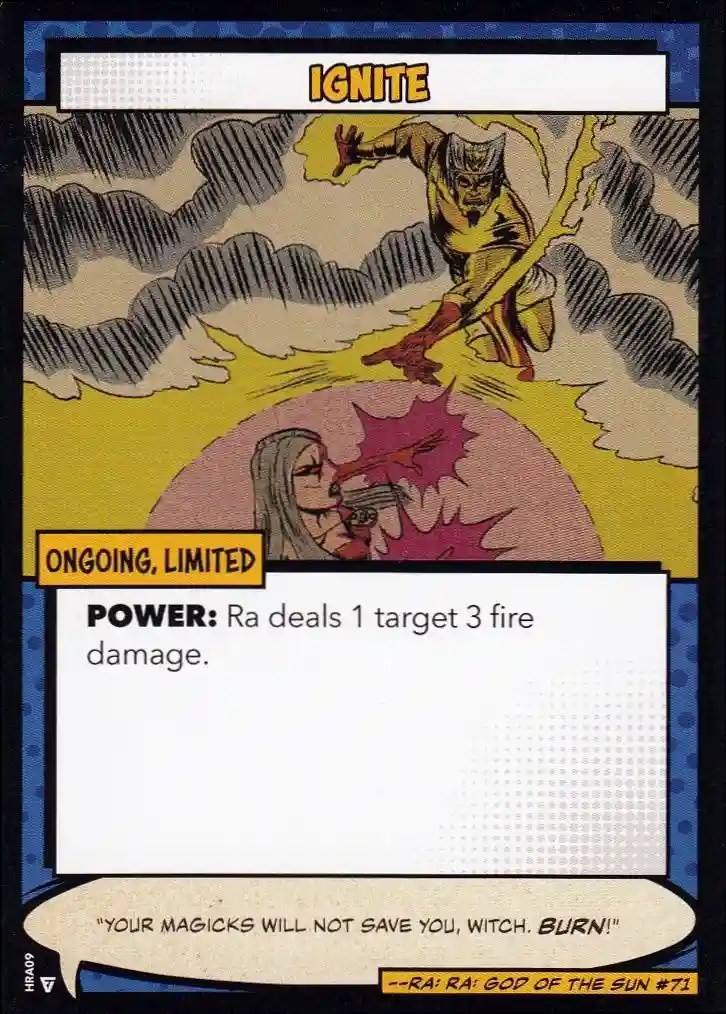
Ignite – Unlike some heroes, Ra only has two additional powers he can use. We’ll talk about the second one later on but Ignite deserves its own discussion because it is the superior power for this hero. Ignite is a slightly stronger source of direct damage than Pyre on the base version of Ra. Ignite is a really important card for the First Appearance version of Ra since Rekindle only does 1 damage. For these reasons, Ignite is always a good card to have on the board since it is your best source of steady damage.
Mass Damage and Damage Boosting Ongoing Cards – This category of cards is very important to First Appearance Ra because you can salvage them as needed throughout the game.
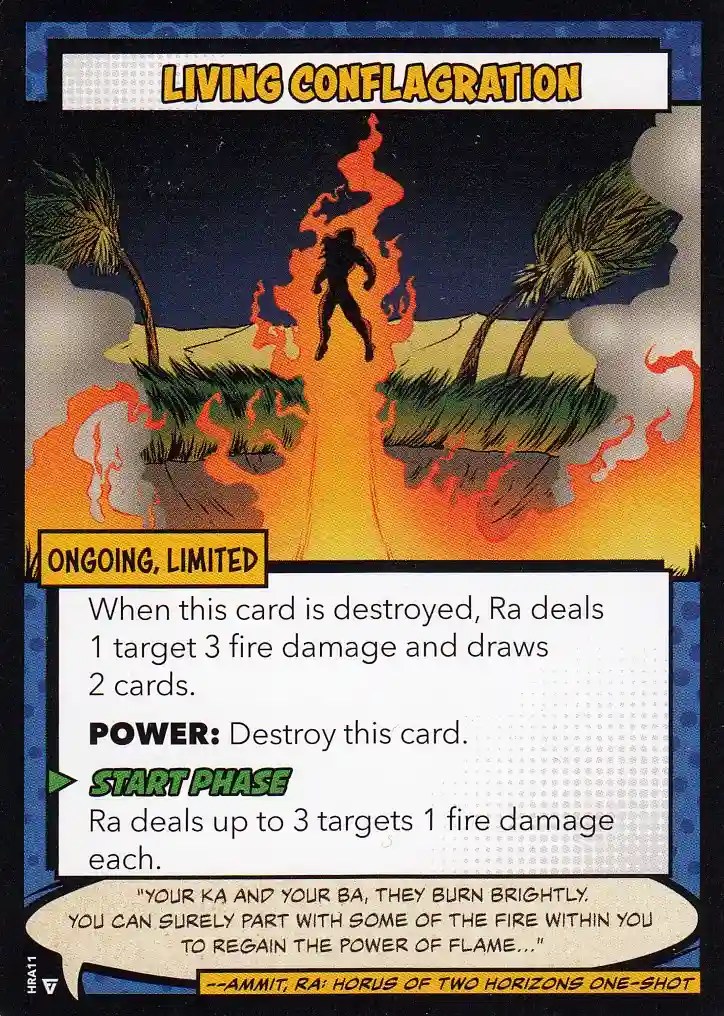
Living Conflagration is a pretty versatile card. It does mass damage during each Start Phase which is quite powerful. While this reliable damage is nice, you can destroy Living Conflagration to do three damage to a single target and draw two cards. Of course, this effect still takes place should a villain or environment card destroy Living Conflagration. As a result, Living Conflagration is great to have in-play when possible. It really helps elevate Ra’s ability to damage both single and multiple targets.
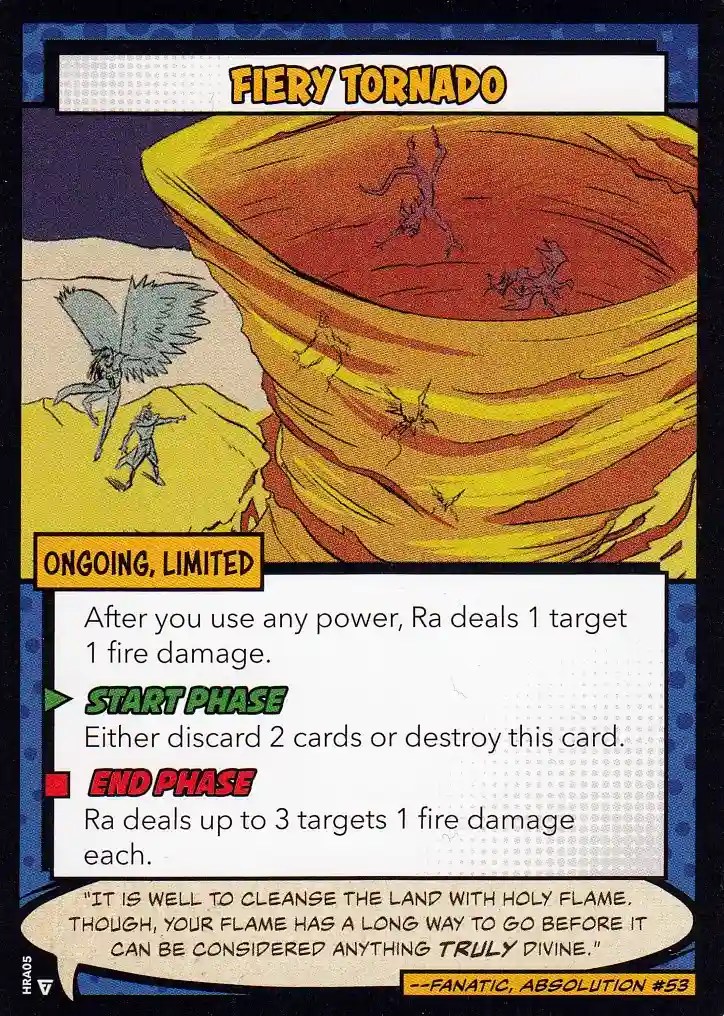
Fiery Tornado also does mass damage though it occurs during the End Phase. It also can do one damage to a single target when you use a power. While this is less powerful than Living Conflagration, it is still fairly nice. The challenge is that you have to discard two cards a turn to keep this effect going. As a result, its unlikely that you’ll keep this card going for more than a turn or two at a time. Overall, I would say Fiery Tornado sits somewhere between a useful and situational card. I would much rather play Fire Blast, Ignite, or Living Conflagration, if possible, but there are cards we’re about to discuss that I would not choose over Fiery Tornado.
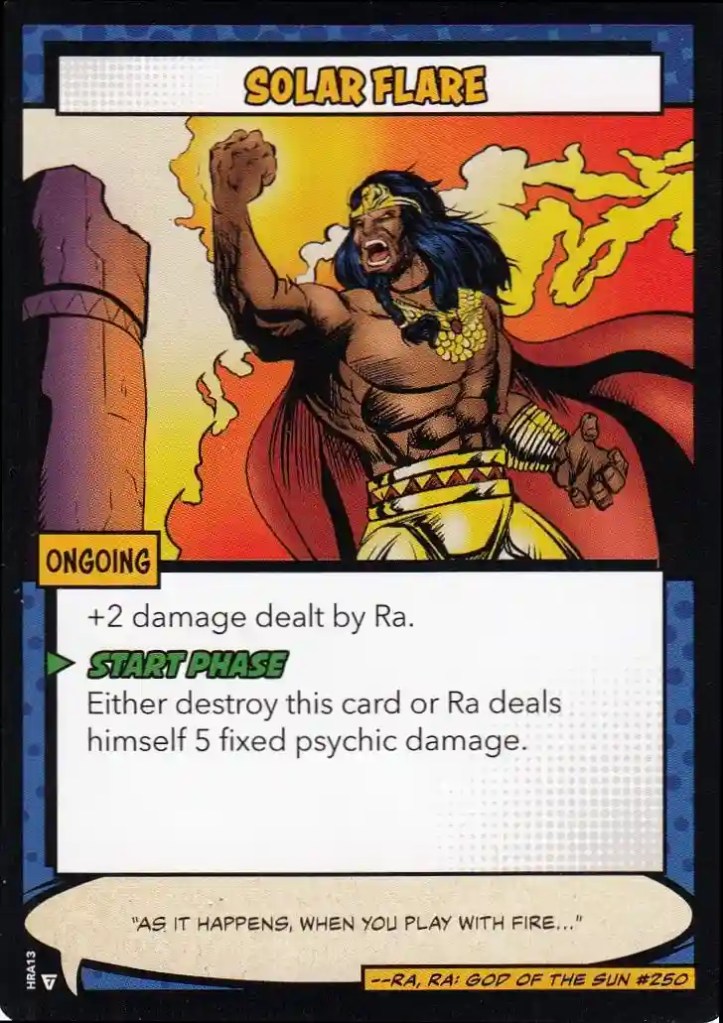
Lastly, we have Solar Flare which gives you the chance to do 2+ damage for each turn you keep it in play. The power this provides is self-explanatory. It turns any damage dealing card along with Staff of Ra into a powerhouse. The five damage per turn is a steep cost though and you want to get as much out of this card as possible to justify that damage. The challenge with Solar Flare is that it isn’t that great if you don’t take the five damage cost and keep it around for two turns. This is because you have to play the card during a turn, it then will boost your power, and then at the start of your next turn, you have to destroy it or take five damage. So this is another card where picking the right time and moment to use it, will make a difference.
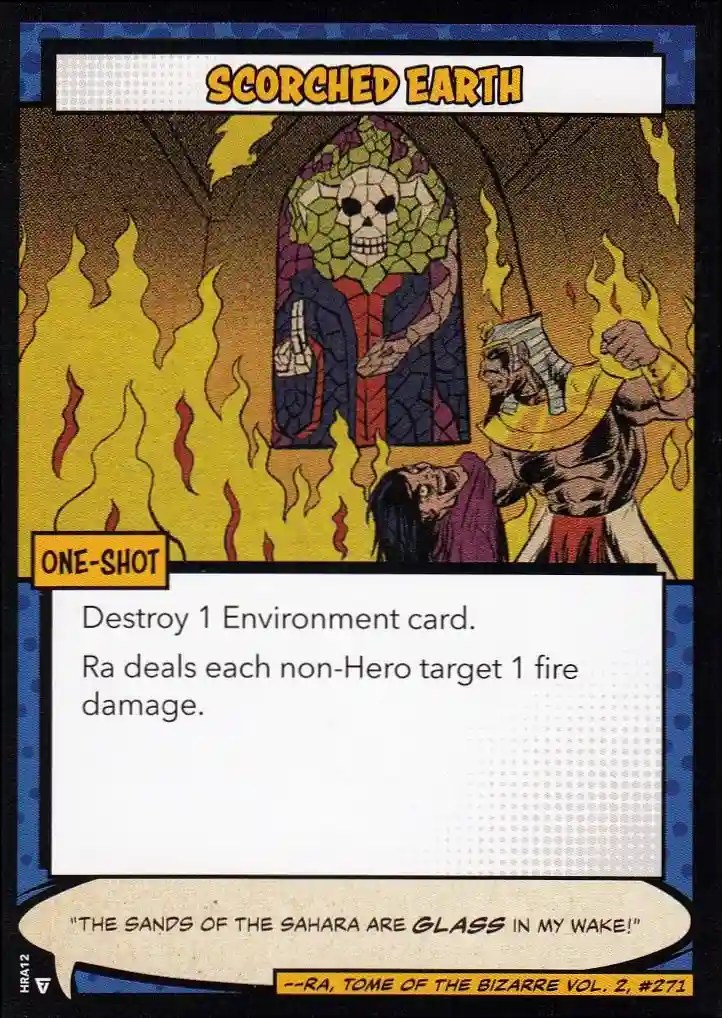
Environment Cards – The most situational cards in Ra’s deck are hard to rank and I actually flip-flopped on my ranking of these last two categories while writing this article. Ultimately, I think the Environment cards are more useful than his defensive cards, in large part because of Scorched Earth. It does mass damage which is nice but the ability to destroy a pesky Environment card is great to have. Most of the different environments have at least one card that has nasty effects and you will want to get rid of so having Scorched Earth in your hand is a welcome sight even if it sits there for a while before you end up using it.

Excavation, however, is a great example of a situational card. It lets you bury environment cards which means taking discarded cards and putting them at the bottom of the Environment deck. You can use this to return favorable cards to the deck or to prevent the Environment deck from recycling as this can cause villains like Akash’Bhuta to flip sides and become more dangerous. Excavation also lets you find relic and ongoing cards like Staff of Ra, Ignite, and Living Conflagration from your deck which is useful. Ideally, you’d be drawing those cards anyway and not need to “waste” time with Excavation but in a pinch, this is one way to get the cards that you need. Ultimately, this is a card I rarely use and that it drags down this category quite a bit which demonstrates how limited Excavation’s usefulness is.
Defensive Ongoing cards – The final set of cards are defensives ones which truthfully, are very situational and not terribly effective.
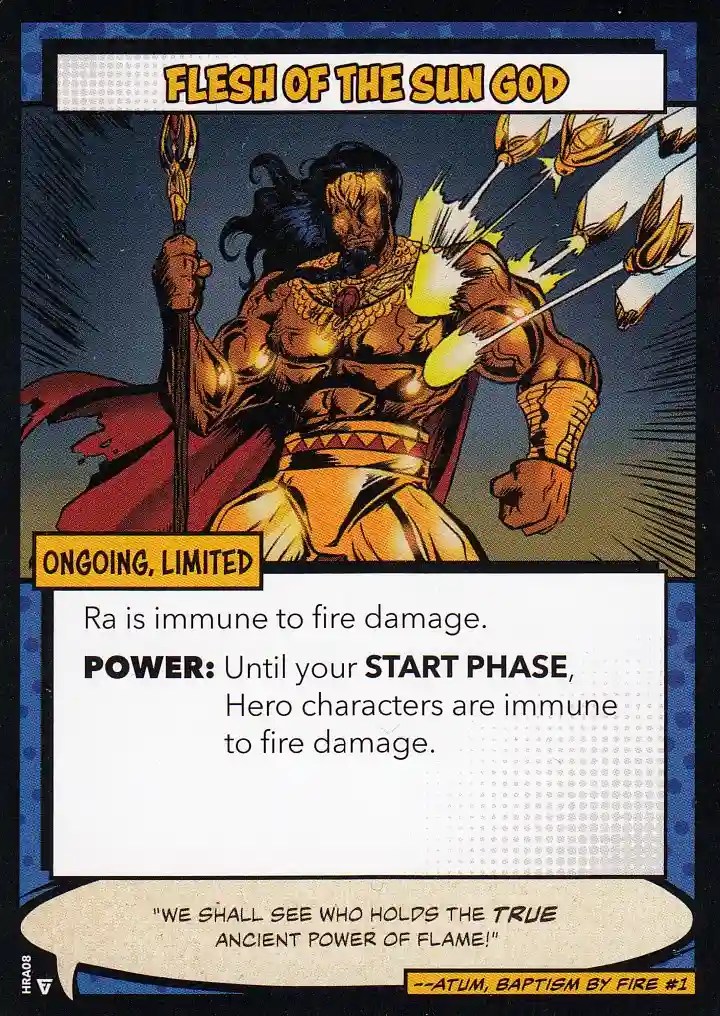
Flesh of the Sun God gives you immunity to fire damage which is powerful if you’re facing off against a villain relying on fire damage. However, most villain decks mix up the damage type on each card and I’m not aware of a villain in the Definitive Edition Base Set that uses a lot of fire attacks. That makes this card not particularly useful. The power gives your whole team fire immunity which, in some very specific circumstances, might be a boon. To get much out of this card, you’ll need to know the environment and villain you’re facing. If they attack you with fire damage, then this card may find some use.
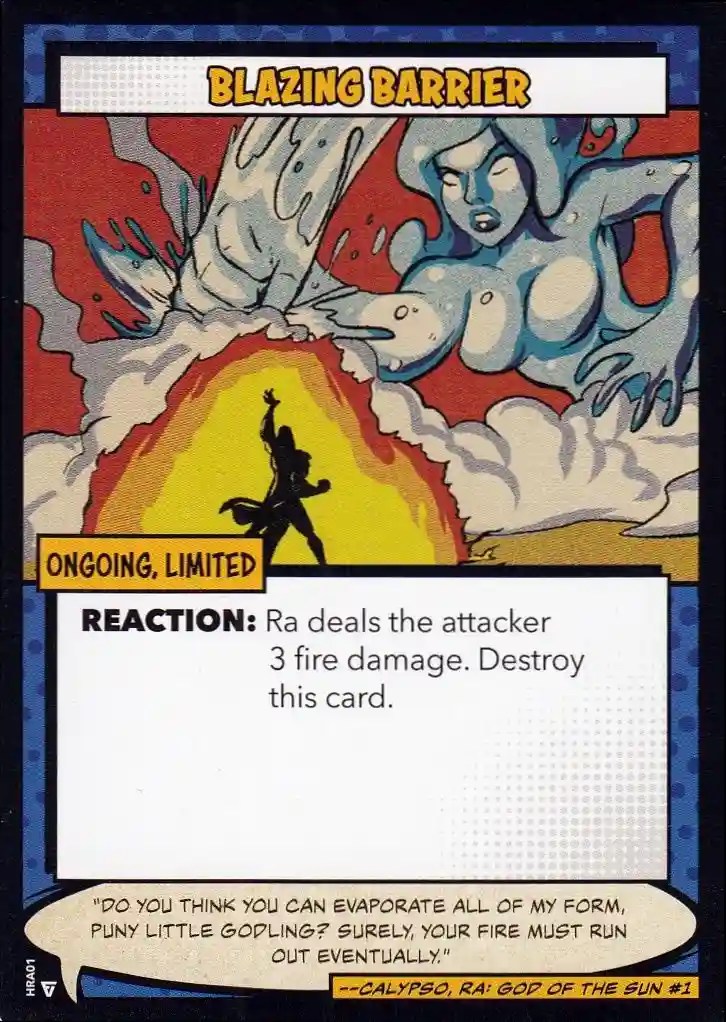
Blazing Barrier isn’t defensive per say as it does direct damage to your attacker but since it requires that you be attacked to have any effect, I put the card in this category anyway. Being able to do three damage is nice but not being able to pick the target taking damage is less so. Personally, I’d rather choose the target and not have to wait to deal damage but Blazing Barrier can still find use, especially as your hand empties and options dwindle.
Strengths and Weaknesses – Ra is a great source for direct damage and there are some fun combo possibilities within the deck. It is a pretty beginner friendly deck since the power of some of the key cards is fairly obvious as well. Ra’s ability to remove a pesky Environment card or two should not be underestimated either. Some other heroes can do something similar but Ra’s environmental destruction is quick and effective. With the exception of By Flame Reforged! and Excavation, Ra is not great at finding the cards he needs to get his powerful combos going. His card draw is limited so your hand tends to dwindle as the game goes on, unless you have an ally that is gifting you some card draw capability, of course. The other major weakness is that Ra has very limited defensive options. This means your main focus should be dealing as much damage as you can while he’s alive because you don’t have a lot of ways to prevent incoming damage. I rarely regret fielding Ra as his deck tends to work well independently of others and he helps you do the thing you have to do in Sentinels of the Multiverse to win games as well.
That brings us to the end of Ra’s Hero Guide. If you have any tips for playing this hero or think I got anything wrong, we’d love to hear your thoughts in the comments below!
 Kuribo's Painting
A very comprehensive review Jeff, that would be a very useful guide to someone playing this game
LikeLiked by 2 people
Thank you, Dave! We’ll see if people manage to find it using the usual search engine suspects or not.
LikeLiked by 1 person
Can’t comment on the game, Jeff, but I enjoyed looking at the artwork! 🙂
LikeLiked by 2 people
Glad to hear it, John! I like the artwork quite a bit as well. It has a nice comic book look to it!
LikeLiked by 1 person
That was an interesting read Jeff, I’ll have to look this game up. I’m partial to card games so things like how decks are constructed in different games interests me. Funny coincidence I was thinking this morning maybe I should do a card game post as a change of pace!
LikeLiked by 2 people
Glad to hear it, Nic! Sentinels of the Multiverse is an interesting game because it has no deck construction which makes it one of the easiest card games to pick up and play. I come from a CCG/TCG background so I wasn’t sure how much I’d like it but I really enjoy the game and am glad I gave it a try. Its a lot cheaper than other card games but still provides a ton of content which is something I like about them. I’ll be curious to see what you have up your sleeve for that article. It sounds interesting!
LikeLiked by 2 people
Never played MTG and have very limited card game experience, so I don’t have a lot of feedback on this one, but if you’re enjoying it enough to write character guides, then that’s great! 🙂
LikeLiked by 1 person
Thanks, mate! Its too bad you didn’t buy Magic because I think you’d be the age where if you had bought Magic when it was new, you’d have some valuable cards potentially 🙂 By the time I got into it, it was too late!
LikeLiked by 1 person
Yeah I was around when the game came out and the card to lust after was the Black Lotus.
Still, a lot of the basic metal warhammer models I picked up now go for silly money despite no intention to sell – so swings and roundabouts!
LikeLiked by 1 person
Black Lotus is still king as far as I know. Even when I was into Magic back then, it was valuable but not nearly as expensive as it is now. I should look up the prices of old Warhammer minis because I don’t know how crazy they are. I got into the hobby late enough that plastics were already around and metal was to some degree being phased out so I definitely missed that time and am now curious how “collectible” Oldhammer is.
LikeLike
Wow, that’s an impressively comprehensive manual 🙂 Good work!
LikeLiked by 1 person
Thank you, mate! I don’t know if this series will continue in the long term but I think the two guides I’ve written are pretty useful anyway.
LikeLike