AK Interactive have become a major player in the scale model and miniature scene and one of the ways they’ve accomplished this is by becoming the biggest publisher of hobby books and magazines. Their ambition can be seen in their F.A.Q. book series. Each book is full of beautiful pictures, has a high page count, and are comprehensive books on a particular topic. Figure Painting Techniques F.A.Q. has been marketed as one of their best and most comprehensive books on painting miniatures yet and so I wanted to share my thoughts on it and try to help you decide if it might be worth owning.

What is Figure Painting Techniques F.A.Q.? – This book is meant to be the one book you need to learn how to paint figures well. And when I say figures, I mean humans as well as some of your typical fantasy races. There is no coverage of vehicles or spaceships in this book. Much of the book contains painting tutorials and the intent is clearly to cover as many topics as possible to help fantasy and historical miniature painters improve their craft.
Who is the author? – Our hobby is a funny thing in the sense that there are painters who have name recognition but mostly amongst other serious or wannabe serious painters. I’ve known of Kirill Kanaev’s work for several years and have always considered him one of the very best in the world. I didn’t realize he was more of a historical painter than fantasy because he used to paint a fair bit of fantasy in the past but regardless, he would always be high on my list of painters I’d like to learn from. In that sense, AK Interactive couldn’t have selected a better person to write this book. If you don’t believe me, take a peek at his CoolMiniOrNot profile where he is rated the 3rd best of all miniature painters. While its true that CoolMiniOrNot, is no longer the place to go to see newly painted miniatures by the best in the world, what Kirill accomplished there is still impressive.
Contents – Because the book is nearly 500 pages, I can’t discuss everything that’s in the book without writing a 5,000 word review so instead, I tried to summarize each chapter and what stood out to me after reading it below.
Materials – This section is great for new hobbyists and describes all the essential hobby tools you might need for a given project. If you’ve ever purchased an art instruction book, this type of introduction is extremely common so its no surprise to see one included here.
Before We Start On Our Figure – This chapter details model prep and some of the wrinkles you might face before painting. Again, this is very useful for new hobbyists and probably less so if you’re an experienced painter.

Colors – The information becomes a bit more advanced in this section. Kanaev shows how mixing different colors can help you achieve different tones. So for example, mixing red with white leads to pinkish tones and red and orange lead to flesh tones. While most of us do not achieve the colors we want by mixing red and white or red and black together to go from a dark shade all the way to the lightest color, this section helps you think about colors in a new and more advanced way. There’s also some useful information on warm vs. cold colors and how to generate color triads. While I’ve not tried this out before, I would like to experiment with color triads in the future thanks to what I read in this section.

Lighting – This section is a must read in my opinion and among the most valuable content in the book. Many people who paint miniatures do so for wargaming. I think its fair to say that we’ve all heard of zenithal highlighting or at least have tried to apply that concept to our miniatures (even if we didn’t fully understand the concept or pay close attention to how accurate it is). However, do you know about the other lighting options you have? I don’t mean Object Source Lighting (OSL) either, I’m talking about nadir lighting, and lighting from either side of the miniature. There are more lighting options than many hobbyists are aware of and using these lighting schemes can really add something to a project, particularly something painted at a display level. As proof of what I’m saying, this part of the book inspired my latest display project (pictured below) where I’m attempting nadir lighting for the first time.
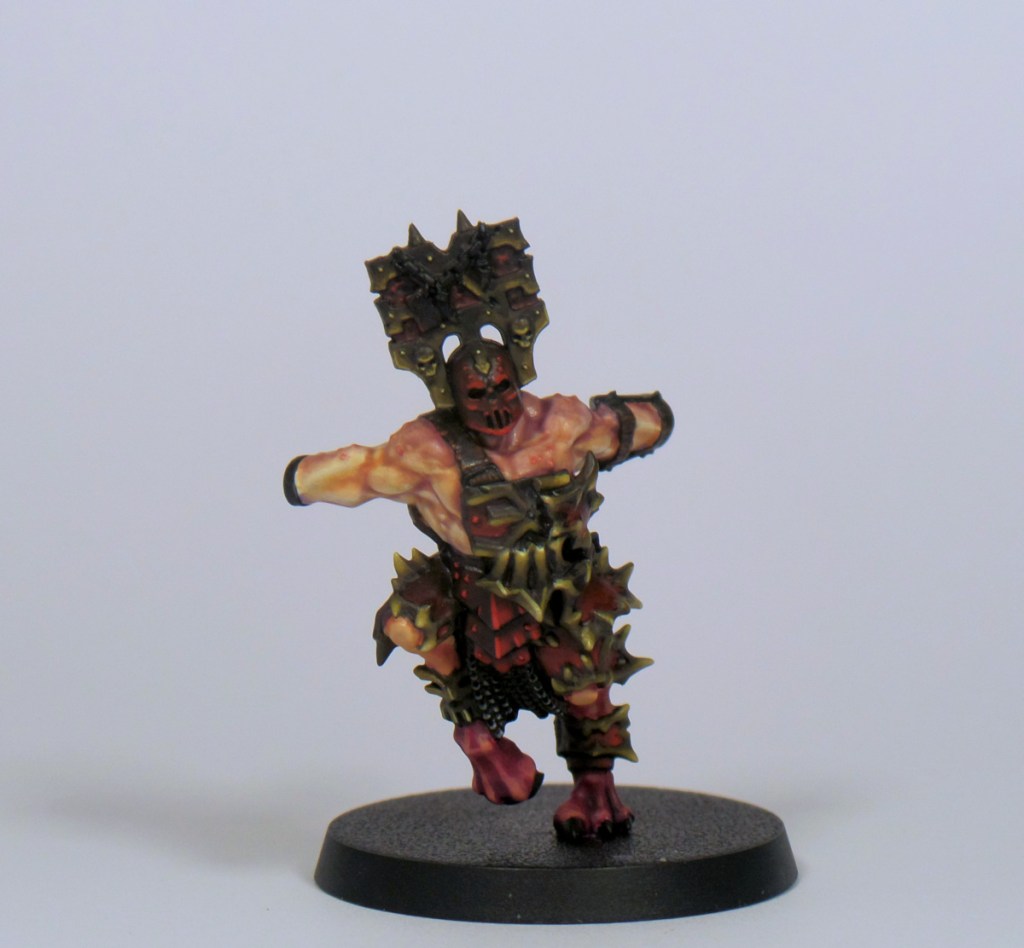
Techniques – After the previous chapter, which gets you thinking about miniatures in an advanced way, this chapter has more straightforward information. Depending on your experience, you might already know how to glaze, drybrush, and/or use a sponge to apply chipping to a miniature. And to state the obvious, there are plenty of Youtube tutorials about these techniques too. With that said, the information is still valuable and well explained here. I think this section is probably most useful to newer hobbyists though there is information on how to use oil paints as well which I think is a topic many painters are less familiar with. I know I learned a bit about them from reading that portion of this chapter.

Painting Figures, Applying Techniques – This is the meat of the book with tons of tutorials for how to handle different parts of a miniature. From eyes, faces, hands, and skin tone to wood, freehand, TMM and NMM metallic surfaces, there is something here for everyone. Perhaps the most impressive section is the NMM which not only goes in-depth on the theory of NMM but also has extensive tutorials. Kirill Kanaev is a master at painting metallics and so the wisdom and techniques he shares are invaluable if you want to learn NMM, especially in larger scales.
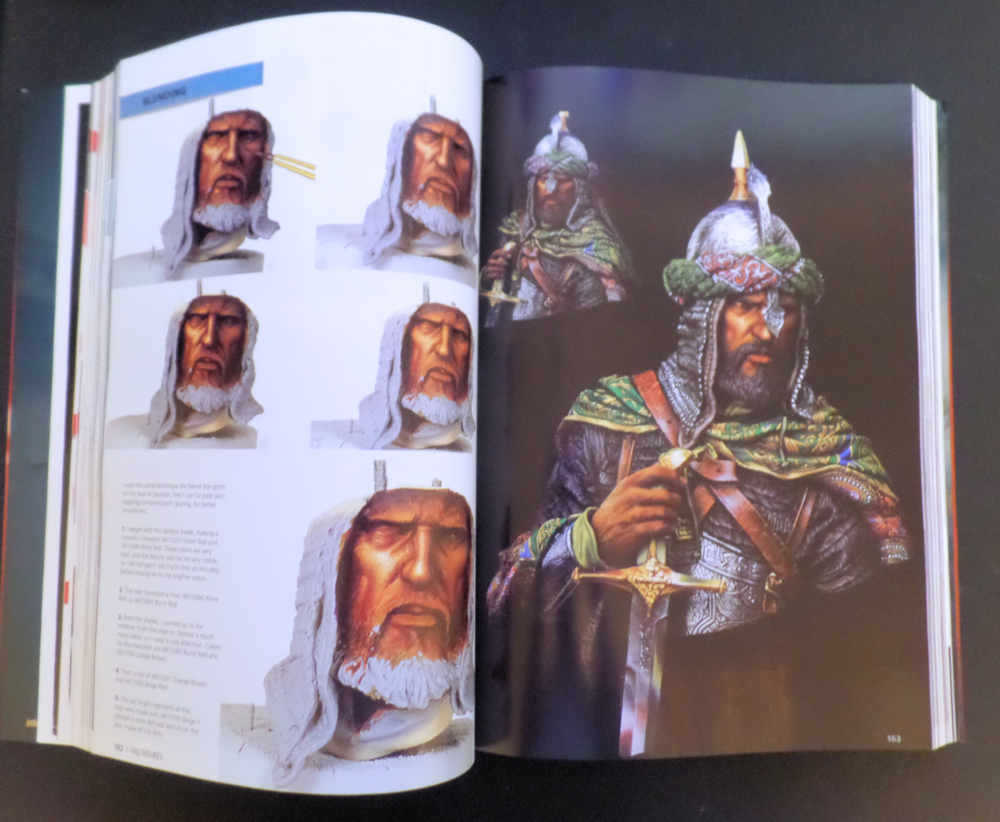
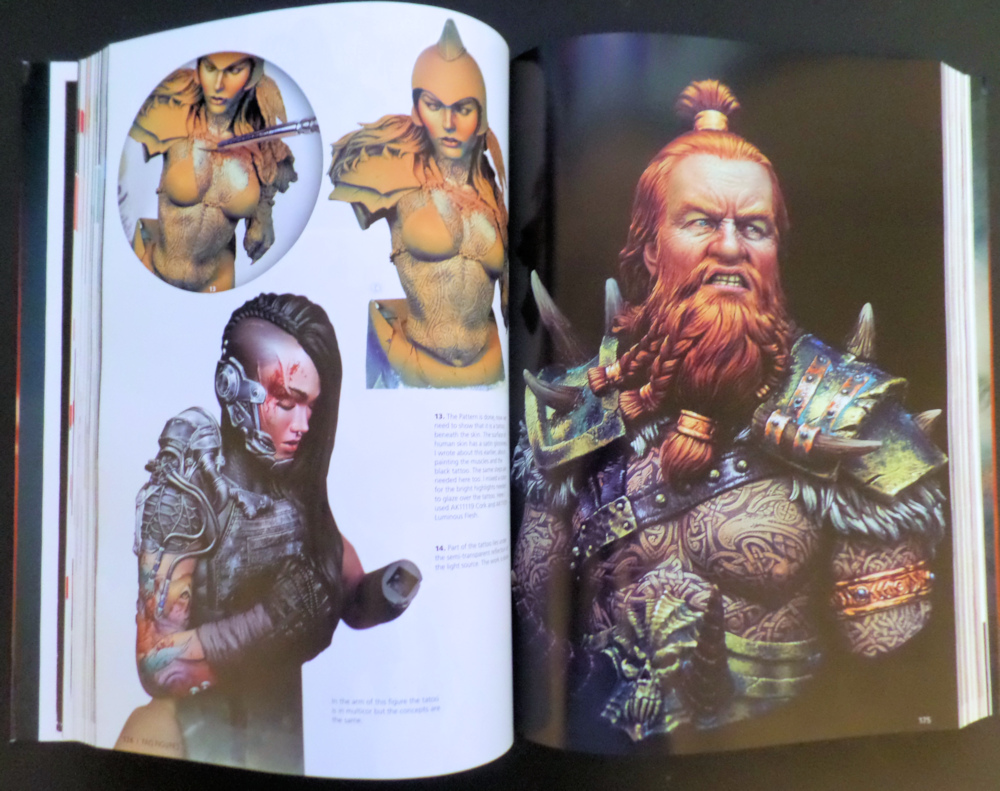
The one thing I will say is that tutorials in a book like this are not necessarily as easy to absorb as watching a Youtube video so I think putting what you see in Figure Painting Techniques F.A.Q. into practice might not be as easy as we’d like, especially when you’re looking at a 20-30 step tutorial. That is no fault of the author’s though and you know what you’re getting from a book versus a video tutorial.
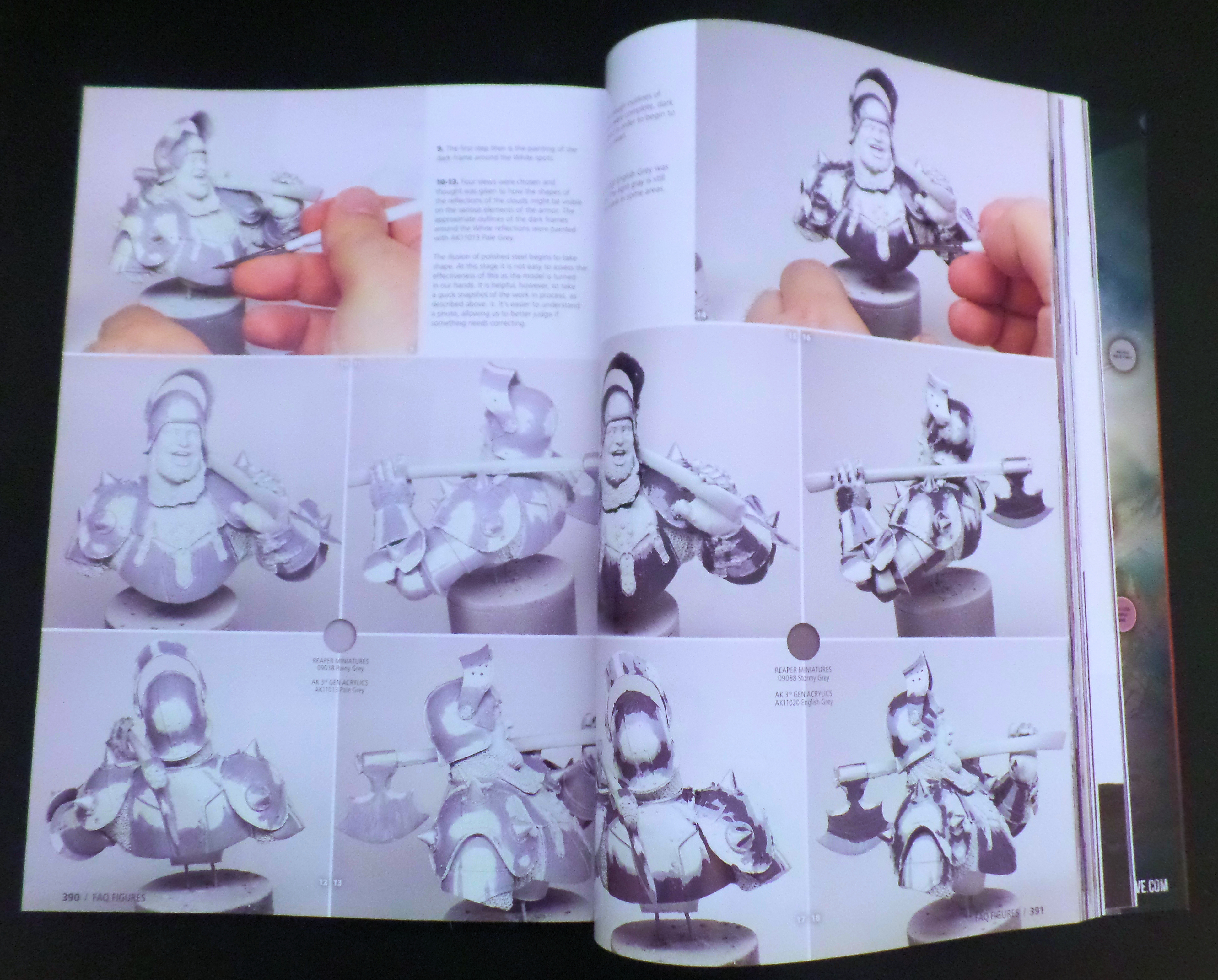
What is the hobby value of Figure Painting Techniques F.A.Q.? – While the tutorials have a tons of useful information in them as I mentioned previously, I think the theoretical information cannot be overlooked either. In miniature painting, theory is not talked about often. For example, it’s not an exaggeration to say that some hobbyists go on Youtube for tutorials to basically have paint schemes given to them. Of course, there is nothing wrong with this if you just want to paint something so you can use it in a game, but if you’re interested in approaching the hobby as an artist or trying to get as good at it as you can, you need to learn some theory to understand why things work and don’t work. This book is a huge help in that regard and I appreciate the author’s refusal to take shortcuts throughout the content. Kirill always goes the extra mile to explain why things work the way they do. The theory isn’t light reading and it can be challenging to absorb it all but its valuable information nonetheless.
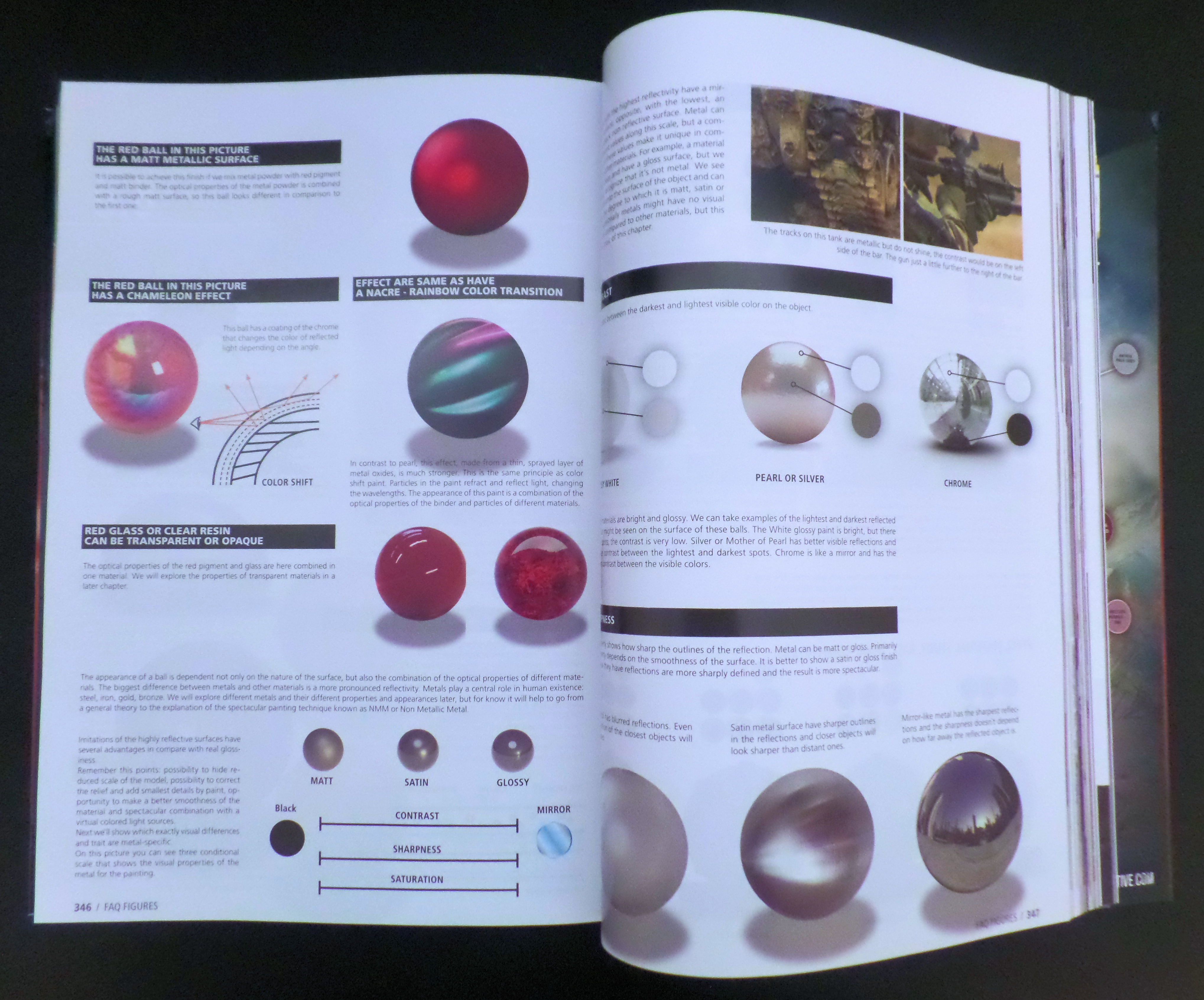
There’s no doubt in my mind that if you can take the information presented in this book and apply it to miniature painting through repeated practice, you can become a great painter.
Who is this book for? – This is a tricky question to answer because there are a lot of people who can benefit from this book but in different ways.
The first thing to say is that the book focuses primarily on busts and large scale miniatures (75mm or larger). Many hobbyists, including myself, paint in smaller scales than that, particularly if you’re into wargaming or Games Workshop’s products. So some of the techniques described can’t really be done at those scales. For example, creating a detailed metallic reflection in a helmet is not possible at 32mm. Even with that caveat, I still think the content of the Figure Painting Techniques F.A.Q. is thought provoking and useful, especially all of the theoretical information. Of course, if you do paint busts and larger scale miniatures, this book is incredibly useful from start to finish and is highly recommended.
But what about in terms of a painter’s knowledge and experience? If you’re a new painter, there is quite a bit of useful information in here but mostly if you’re interested in display painting. The opening chapters all have great info and it’s never too early to be aware of lighting, TMM, and NMM techniques as well. However, these techniques are time consuming and are not likely to be useful if you’re just painting to game. While there’s no doubt that some parts might go over the head of a newer hobbyist, that doesn’t diminish the value of the book. If anything, it means you can grow into this one and continue to refer back to it as you gain experience.
For advanced painters, which is where I would humbly place myself, this book undoubtedly spends some pages on content you should already know (the first two chapters) but the more advanced theory and tutorials make up for that. Its also worth noting that the book spends way more time on theory and tutorials than it does on beginner information. Ultimately, some of the information in this book is simply not found on Youtube or any other places besides advanced painting seminars. For the reason alone, the book is worth your consideration.

Finally, it’s worth mentioning that no matter where you are experience wise, the images are high quality and inspiring as well. The pictures in this review do not do the paint jobs justice because my camera doesn’t do well with black or glossy finishes. I think you would struggle to find a book that has more high quality miniatures in it. AK Interactive did a great job of balancing historical and fantasy subjects in the imagery as well so there’s something for everyone here.
How well is the book edited? – AK Interactive have a bit of a spotty record when it comes to how they edit their publications. Many of their publications seem to be put through some kind of a translation service for their English releases. The end result is something that generally makes sense but has some odd word choices or phrasing. Thankfully, this book did not go this route and it feels like it was written by an English speaker. There are some somewhat bizarre typos and spacing issues in the book but they thankfully do not impede your ability to understand the information.
Closing Thoughts – As you can tell, I found Figure Painting Techniques F.A.Q. to be quite valuable and inspiring. I’m happy with my purchase which is good because the book is not cheap. Here in the US, it ranges from $90-130. The quality is certainly there to justify the price and at 480 pages, its hard to imagine that either Kirill Kanaev or AK Interactive could have added too much more to this weighty tome. No matter what scale you paint, there is something you can learn from this book. And so, if you’re interested in the contents and are comfortable with the cost, I would certainly recommend this one. You won’t find a more thorough exploration of miniature painting or a more talented artist to guide you through it.
 Kuribo's Painting
Nice review, seems like an interesting book for sure. If I see it locally might try to pick it up!
LikeLiked by 4 people
Thanks for giving it a read and hopefully it isn’t much more expensive than it is here in the States, I think that might be the only thing that keeps people from getting this one. $100 for a book is nothing to sneeze at!
LikeLiked by 3 people
Great review, mate! The book looks interesting and informative and while YouTube tutorials have their place, having them in printed form also works well for me as the steps can be described and gone over without needing to pause/rewind/play again constantly in those times when you’re really absorbing something new. I looked it up and found a place locally where they have the book for AU$150ish, which isn’t bad compared to US prices but does throw it well past an impulse purchase. Maybe something to pick up down the line…
LikeLiked by 6 people
Thank you, mate! That is a very good point on Youtube tutorials and something I don’t enjoy about them either. I’m glad to hear the book isn’t too much more expensive there overall too. It is certainly not something you can pick up on a whim (unless you’re independently wealthy). I sold some MESBG stuff that I wasn’t using to help fund this purchase myself so I can totally relate to what you’re saying.
LikeLiked by 2 people
Well done getting a concise review done for such a comprehensive book! 🙂
LikeLiked by 4 people
That is great to hear, John! I wanted a review that was thorough but hopefully interesting to read and not too time consuming. Thank you for giving it a look 🙂
LikeLiked by 3 people
Excellent review Jeff, and sounds like it has something for everyone in there, it’s certainly a book I will consider, as I always like learning new techniques.
LikeLiked by 3 people
Thank you for giving it a read and yes, I think there is an excellent range of painting information in this book. I think its something I will reference often in the coming years.
LikeLiked by 2 people
Another very through review! Looks very tempting but I feel all it would do is take up shelf space for me, I’m quite happy with my tabletop level of painting.
LikeLiked by 3 people
It would be quite an expensive paperweight at that! This is definitely for anyone who wants to push their abilities as far as they can which is not everyone’s cup of tea. Since you paint a lot of 28mm you’re about as far from the larger scales in the book as you can realistically get too!
LikeLiked by 1 person
Nice review. Though I would caution any newer miniature wargamers against anything that says advanced techniques for painting. When one is new it’s more about getting stuff on the table and playing then it is about getting good paint jobs. Often people can feel intimidated by good paint jobs thinking that is the standard of the hobby. 😀
It’s probably best for folks who are already mid level and want to increase their skill.
LikeLiked by 4 people
That is fair advice. It really depends on what your focus is. Throughout my painting career, I’ve always wanted to improve and get as good as I can whether its for gaming or for display. So I was recommending it for new people with that mindset in mind. However, there are plenty of people who aren’t solely focused on quality (which is totally valid) and so I tried to clarify that in the review.
LikeLiked by 1 person
I enjoyed reading the review – and as John said – very tough to be so concise on such a subject. I would buy this but not at this price – hell, Youtube is free and as a wargame painter I think that getting figures to a great standard is about all I’ll strive for. Plus, at my scales (25-28 mm and 15 mm for tanks and AFV’s) not sure that this would help. After all presbyopia comes for us all! Anyways thanks much for sharing – you did an excellent job on this post.
LikeLiked by 3 people
Thank you, Mark! I’m glad to hear it. The price is definitely a deterrent. Personally, I’d like to see a book like this but for 32-28mm miniatures and a focus on “gaming” techniques. I think that could be a shorter and less expensive book and there’d be a big market for it.
LikeLiked by 1 person
Thanks for the comprehensive review mate! It is always amazing to me to see what can be accomplished with skilled painting techniques. I am a mediocre painter but I know enough to appreciate the skill that goes into it. It is fun to read your thoughts on the various elements of the book, so thanks again.
LikeLiked by 2 people
You’re welcome and thank you for giving it a read as well. I’d say the upside to our hobby is that there is always something new to learn if and when you have the desire. I think that’s why I’ve been able to stick to this hobby after bouncing around like a hobby butterfly for a few years.
LikeLiked by 1 person
Nice review and it sounds like a very interesting book, and I’m glad you feel like it has helped you.
LikeLiked by 2 people
Thanks for giving it a read, mate! It definitely has taught me some new ideas and tricks that I hope to try out in the coming days.
LikeLiked by 2 people
If all it does is inspire your Chaos warrior with the lighting from below then I think its money well spent! But if you can get some more great ideas like that then thats even better!
LikeLiked by 2 people
There is at least another idea it has given me for down the road so I’ve done pretty well with it, I’d say!
LikeLiked by 2 people
Nice review. Since the other half of my paycheck comes from AK, I no doubt heard of this book before! 😂
As Azazel said, I don’t always want to go to a YouTube video for some technique. The back and forth rewinding or even just trying to remember whose video I had watched can be problematic. So having a reference book is pretty useful. Especially if it’s a technique that I’m familiar with but just need to refresh my memory on the finer points.
I passed on this book originally because of the price and most of the tutorials I had seen from AK suffered through translation. Glad to hear that isn’t the case in the book.
Do they happen to mention pigmentation in paints when mixing colors? That’s always been a pain. Trying to highlight a brown with a white or yellow and then getting a muddy grey because of some random pigments the manufacturer put in is such a pain.
Ok, I’m signing off. Subliminal message of the day “Buy more AK paints!”.
LikeLiked by 1 person
I’m sure you’ve been shilling this book to anyone who will listen haha! 😀 Also, I can’t imagine the translations are too bad for you because if you work for AK, surely, you speak pretty fluent Spanish! 😉
I don’t remember there being a ton of discussion on pigment. AK Interactive has a book just about colors and it runs about $50. Its called How to work with colors and transitions. I’m very tempted to get it because nobody else has written much just about color when it comes to our hobby. People who have mastered color can make their work stand out too which is always helpful.
Finally, you don’t have to hard sell me. I am impressed by AK paints and like it better than Citadel’s or Vallejo’s truthfully!
LikeLiked by 1 person
Oh, that book on colors sounds pretty interesting…
Maybe they don’t mention the pigment issue because they have the highly pigmented paint. Technically if you use those, you should get exactly the right colors. Though I’m pretty sure I’ve run into the same issue with some of AKs paint. It’s just one of those gambles. Makes me kind of want to do some swatches of paints mixed with different colors to see what the highlight should
look like beforehand. But alas I’m still trying to finish my Reaper swatches. Will see. I did like that swatch chart picture where I think they were showing colors being lightened. I’ve seen Rhonda Bender do some examples of that, which was really cool.
LikeLiked by 1 person
If I stop finding other things to spend money on, I will definitely pick up AK’s color book in the near future.
You might be right on the pigmentation issue as well. I’m not entirely sure. I do know that the AK book has a lot of swatches in it which I think could be very handy for getting ideas. I’m sure the book is geared towards selling their paints but hey, you gotta earn a commission somehow I figure! 🙂 I think you might have to bring back the swatches when you get time too!
LikeLiked by 1 person