In our first entry of this series, we looked at Robert W. Chambers and his contributions to the Arkham Horror Mythos. This time around we’ll delve into an author that was a friend of Lovecraft and toiled for many years as a pulp writer. Frank Belknap Long was a member of the Lovecraft circle of friends and frequently corresponded with H.P. Well after Lovecraft’s death, Belknap Long even wrote Howard Phillips Lovecraft: Dreamer on the Nightside, which is a short biography that tries to rehabilitate Lovecraft’s reputation. As I will discuss shortly, he not only survived Lovecraft but the influence of the seminal author is undeniable on Long’s work. Frank Belknap Long was a fascinating person in that he was a pulp writer who made his living writing for pulp magazines, only to watch them fall out of favor and have to pivot in his career to keep making money. He wrote in other genres as his career progressed to try and make money in a changing landscape for authors. Sadly, being a writer is rarely lucrative and his elder years were spent in dire poverty. So much so that he was buried initially in an unmarked grave until friends and fans of his work pooled enough money to get him a proper grave marker. This sad end to a prolific author’s life is one of the reasons I wanted to investigate his work and hopefully inspire others to consider checking out of some of his work.

In terms of Long’s writing style, it is less literary than H.P. Lovecraft’s which makes it pretty easy to read. Unfortunately, the trade off is that Belknap Long is not nearly as skilled at providing interesting descriptions and even sometimes his ability to describe action clearly is a little suspect. As was previous mentioned, you can tell he writes for pulp magazines as the stories often have pulp sensibilities and are designed to take you as the reader on an adventure. They rarely are set in mundane locations as a result. Long’s father was an avid fisherman and indeed, he writes quite a few stories with aquatic settings. These are quite often some of his better short stories as the setting works well with cosmic horror since the characters are trapped on a boat which naturally ratchets up the tension.

As you might expect, Long is inspired by some of Lovecraft’s stylistic choices as well. For example, he sometimes references made up pieces of occult literature, though not nearly as frequently as Lovecraft does. He leans on a lot of familiar settings including Egyptian-inspired horror and eerie museum exhibits. Unfortunately, his work does contain some elements of racism as well. There is the more casual, ignorant racism where all the characters are Caucasian and every other culture is odd and mysterious to them, which is pretty easy to ignore. There are a couple of stories where it gets more into H.P. Lovecraft territory where the “villain” is non-white and the depiction of them is racist which is less forgivable. The Death-Waters is the worst of these and while it is offensive, it is still not as bad as Lovecraft’s worst, thankfully.

All in all, I would describe Long’s work as yeomanlike and what I mean by that is that he is a solid writer but he rarely achieves the heights that Lovecraft managed. A lot of his work is fine or even good but somewhat unremarkable. Part of that is because he rarely manages to create truly memorable characters or envision new horrific moments. He also uses familiar settings that you’ll find in Lovecraft’s work so that his stories often feel familiar and lack true surprises. Long also has a tendency to write in present tense up to the moment of horror and then skip ahead in time to describe the after effects of the monsters. This deprives the reader of the horror because it happens all in the past tense and we don’t get to fully experience the tension. Lovecraft does a much better job of depicting cosmic horror than Long does, truthfully. Its also worth mentioning that Long enjoys science and science fiction which you can see in quite a few stories. It is not uncommon for a scientist to feature in his stories as well which might help explain where the scientist/researcher character archetype in Arkham Horror.

Because he wrote a lot of stories that are good but not great, I’m going to highlight the most interesting stories in the collection, The Golden Age of Weird Fiction: Frank Belknap Long – Volume 1. My advice if you’re interested in doing an Arkham Horror Reading Tour is to focus on the stories highlighted below as they not only happen to be Long’s best work in this genre but they’re also going to be the most interesting to fans of Arkham Horror.
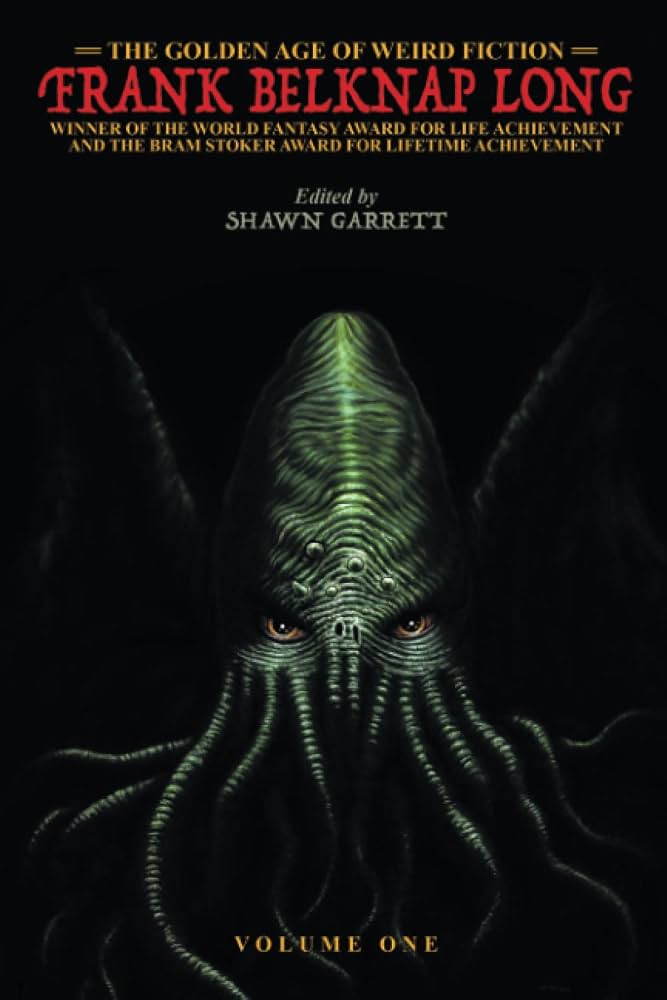
Unfortunately, I would be remiss if I didn’t mention that while The Golden Age of Weird Fiction is a steal digitally (it is $0.99 in the Apple Bookstore at the time of writing), there is a tradeoff for the price. It is rife with typos. The editor has a note in the beginning to please contact them if you spot any which certainly got an eyebrow raise out of me. Once I started reading, it is clear that this book has a lot of typos that haven’t been corrected yet which is a real shame. Its borderline disrespectful to the author’s work. Unfortunately, this is the only “in-print” way to get Belknap Long’s work so its something you have no choice but to stomach. There is also a second volume in this series that has later works from Long. The stories are arranged in chronological order so you can see Long’s growth as a writer across the stories which is nice. My assumption is that the second volume is later era works from the 1940’s and beyond. The final story in this collection was published in 1939.
Here is a list of all the stories in the collection and then I’ll talk about the best ones of the bunch and my thoughts on them.
- At the Home of Poe – This is a poem
- The Eye Above the Mantel
- In the Tomb of Semenses
- The Desert Lich
- Death-Waters
- The Sea Thing
- The Were-Snake
- Men Who Walk Upon the Air
- The Devil-God
- The Ocean Leech
- The Dog-Eared God
- The Man With a Thousand Legs
- The Space Eaters
- You Can’t Kill a Ghost
- The Hounds of Tindalos
- The Red Fetish
- A Visitor from Egypt
- The Horror from the Hills
- When Chaugnar Wakes – This is a poem
- In the Lair of the Space Monsters
- Second Night Out
- The Dark Beasts
- The Great Cold
- Dark Vision
- The Creeper in Darkness
- The Elemental

The Man with a Thousand Legs – This story is interesting because you get to see a writer starting to grow and experiment with new ideas. The previous ten or so stories are pretty short and straightforward. The Man with a Thousand Legs is longer and the author plays with perspective so that you experience something strange through multiple character’s eyes which helps you slowly piece together what is going on in the small town. Of course, the monster is creepy in a Lovecraftian manner and is an aquatic menace. This is also one of the first stories where Belknap Long starts to show his interest in science, which becomes a running theme in later stories. All in all, this is more ambitious and enjoyable than the previous stories which makes it worth reading.

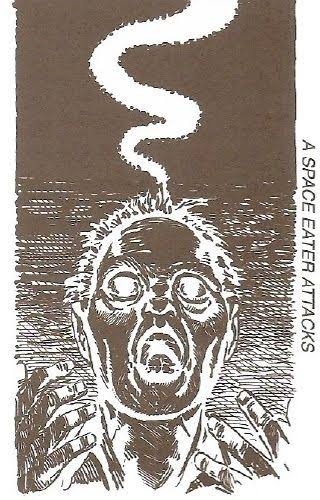
The Space Eaters – And out of seemingly nowhere, you have a really different and interesting story. In this story, Belknap Long makes a surprising and interesting choice, he uses himself and HP Lovecraft as characters in a cosmic horror story! It’s a decision that is worthy of some literary analysis, if that hasn’t already been done before. Surprisingly, I don’t see very much about this story online, which is a shame as its quite good.
HP’s character talks quite a bit about being a cosmic horror author and how hard it is to capture horror in a way that moves people. Indeed, the character is very serious about it and so when he and Frank get mixed up unwittingly with an elder god, Howard is very earnest about turning it into fiction. While this is not played for laughs, I did find it amusing as from what I do know about HP, he was pretty serious about literature and so the character might have been inspired by the real person in this case.
I would be remiss to not talk about the cosmic horror which is especially horrific here. Some kind of strange, ethereal being that thrives in deep fog can somehow drill a hole in your head and essentially eat your brain and there’s nothing you can do about it once it begins! This being is fairly random in how it attacks people which makes it all the more sinister.
When you combine the interesting decision to write himself and Lovecraft as characters with some truly horrific cosmic horror, you’ve got a pretty strong read. If you like Lovecraft, this one worth hunting down as it is an interesting story to see how his character is depicted and how the story ends. I’d love to say more but I don’t want to spoil it!

The Hounds of Tindalos – This is the short story that Arkham Horror fans will immediately recognize from the title. The hounds are a recurring enemy in Arkham Horror that are inspired by this story. This is undoubtedly one of the better stories in this collection. It features time traveling (by taking drugs no less!) which results in some fun segments where a character briefly travels through history but of course, they go too far and end up meeting the Hounds of Tindalos. And what fierce hounds they are! The weakness of this story is that all of the cosmic horror happens off camera because it isn’t the narrator that experiences it. While the narrator does find the mad ravings of the victim which kind of takes the reader to that moment, it isn’t as effective as if the narrator themselves experiences the horror and the writer has to document it for us. With the exception of this missed opportunity, there is plenty of Lovecraft influence in this story, not least of which is the raving about odd, unnatural angles.

The Horror in the Hills – This is the longest story in the collection and is actually a novella and not a short story. While there are cool moments like a horrific idol coming to life and physically beating a character before choosing them to carry out a foul task and some vivid details about a cosmic entity in Roman times, ultimately, it is just not well-written. The beginning is intriguing and then all momentum of this story slowly peters out over the course of 100+ pages. The descriptions of science (which seems more like pseudo-science to me) in particular are mind-numbing and disappointing. It’s a shame as this could have been a really strong story in more capable hands and indeed, at least some of the dream segments were given to Belknap Long by H.P. himself. There are some strong elements here but they’re weighed down by poor authorial choices.

The Creeper in the Darkness – This short story suffers from a lot of the things typical in Long’s work and resolves itself too cleanly for my taste but it is a nice Lovecraftian surprise nonetheless. It is about an antiquarian who visits a witch house and discovers there is a small resident that has been “haunting” his family for years. What the familiar does is fairly gruesome and creepy as well. While Lovecraft dabbles in these kinds of themes in his work, Long does not up until this point in his career and so that makes this story stand out in a good way. After all, you can’t have Arkham Horror without a visit to witch house.
While this is not a comprehensive look at Belknap Long’s cosmic horror work (there is a second volume of the Golden Age of Weird Fiction for anyone interested), it is meant to be an aide for anyone seeking to read the Arkham Horror Mythos. That is the main reason I don’t necessarily recommend reading everything by Belknap Long. His best work is worth your time but the other stuff is far from necessary and does not appear in Arkham Horror as best as I can tell. With that said, Belknap Long deserves to be remembered and celebrated for his contributions to the mythos and his best work proves that he belongs there. He is not merely defined by his friendship with Lovecraft and he probably deserves a bit more attention than he currently receives as one of the more forgotten members of the Lovecraft circle.


Great review Jeff, sounds like a lot of old stories all suffer from racism, and sexism, which is very much a sign of the times of writing, growing up in the 1970’s it was still rife then, and even certain writers in the modern era can be guilty of it. I think we had the discussion about Y the last man, being totally out of date as it was based on the last man by Mary Shelly which was written in 1824-1825 when women weren’t allowed to do so much in normal every day life, and if the event actually happened now, the world wouldn’t stop as women are in most fields now.
LikeLiked by 1 person
Indeed, I remember that well! HP Lovecraft wasn’t the first to write cosmic horror, but he is still considered the father and the key architect of the genre and deservedly so. The challenge is that his work is racist, much more so than Frank Belknap Long’s. They both have a kind of casual and accidental racism where everything non-white is exotic (and thus a great source for cosmic horror) but the single story I highlighted here (Death Waters) and quite a few of Lovecraft’s work go beyond that. Lovecraft was reclusive and kind of a shut-in and so he feared the outside world and things that were different which inspired his work quite a bit. It isn’t so much that he is a card carrying member of the KKK (though he was racist and there is no hiding it), it is just that it permeates a number of his stories and is something you have to live with when reading his work.
Interestingly, Arkham Horror understandably removes the racism from all of their games. They deliberately use diverse characters and there are lots of female characters which most cosmic horror from the pulp era eschews from other than damsels in distress. You would think this would cause a lot of complaining in the current political environment but I don’t see it all that often.
Hopefully some of this is new information or at least interesting to you! I certainly can’t think of another genre where you have to tolerate racism to some degree to enjoy it. I have no idea what I will read next for this series but perhaps looking at some Lovecraft stories is the next logical step!
LikeLiked by 1 person
Oh, reading this was a lot of fun! I think it was a couple of years ago when I had a spate of reading non-Lovecraft mythos stories, and read Hounds of Tindalos because thought it would be important, and Horror from the Hills. Neither was very good, though, from what I remember! My overriding memory of Tindalos was all the people who murmured or muttered, there was nobody who seemed to just speak normally 🤣
Thank you for your service on this, anyway!
LikeLiked by 1 person
Thanks for reading it! 🙂 I liked Hounds of Tindalos fairly well, even with its flaws but it isn’t as epic or iconic as much of Lovecraft’s works to be sure. Horror from the Hills was pretty disappointing because I felt like I should have liked it and it just wasn’t well written. If I would recommend one story, it is The Space Eaters which is quite good and interesting to read with Lovecraft appearing as a character. With that said, the vast majority of the stories in this collection are somewhat forgettable and it was a chore to read overall. I stopped a couple of times to keep from burning out so service is a great way to put it! 😀
I have no idea what I’ll read next for this series. There are so many options to explore from revisiting Lovecraft, Clark Ashton Smith, and Robert E. Howard, to name a few, but I also am tempted to read some DC/Batman stuff so we’ll see where I go from here!
LikeLiked by 1 person
I had to go back to my review of Horror from the Hills to remind myself, apparently it includes verbatim a dream recounted from Lovecraft to Long? Seems that’s possibly the only redeeming feature – though I always like to read these things at least once, to see where the various mythos entities came from!
Just to add another one to the list, Henry Kuttner was a bit of a discovery for me back in the day, he wrote some fairly decent stuff! Though I think I would equally second DC 🤣
LikeLiked by 1 person
That’s my understanding with the dream sequence. I think the beginning is decent with the idol coming to life and torturing a character but there’s a lot of bad stuff in the rest of the story, sadly.
I haven’t heard of Kuttner but now he is on the list! There really is a lot to read in the genre, even just the stuff that was released closer to Lovecraft’s life. I’m trying to resist the urge to read DC stuff a little longer because I’m worried it will make me really want to paint Batman miniatures. We’ll see how long I can hold out, probably not too long!
LikeLiked by 1 person
Oh, I forgot you’d bought some Batman minis! That does put a spin on it… 😃 According to my research, Kuttner was younger than Lovecraft but still somewhat in his circle, HP gave him notes on a few stories etc. He created Nyogtha, which was used as an ancient one in the older board game version of Arkham, so there you go 😃
LikeLiked by 1 person
Just one for now but they are likely to multiple in due time 😉 That is very interesting and makes Kuttner worthy of reading for sure. When I get around to his work, you’ll know where to find it!
LikeLiked by 1 person