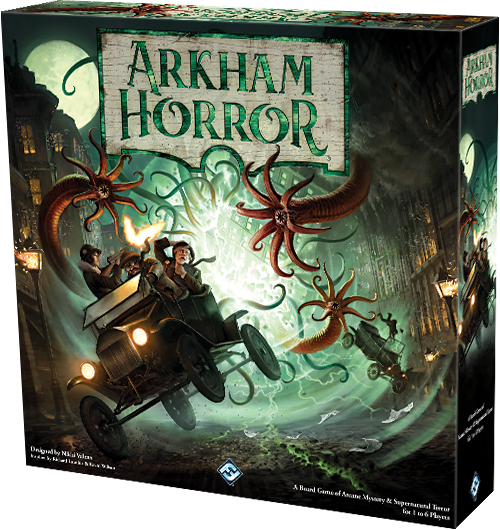
I started playing Arkham Horror: Third Edition late, pretty much at the end of the game’s life in terms of new content being released. And yet, you can easily find copies in the United States at the time of writing and has received decent expansion support from Fantasy Flight Games. Despite this, the game has somewhat of a mixed reputation amongst board gamers which I feel does it a disservice. I’ll try to tackle the criticisms later in the review, but I’ll just come out and say that I think Third Edition is a very good game and it might be something that a particular group of people would be interested in, if they haven’t already tried it. As part of this comprehensive review, I’m going to talk about what I think the strengths and weaknesses of Arkham Horror: Third Edition and compare it to Arkham Horror: The Card Game to help you decide if it might be for you or not.
Before I begin, I should mention that I’ve played the game 10-15 times. I’ve played all of the scenarios and beaten all but one, Echoes in the Deep. I play solo exclusively and I’ve had fun playing with two and three investigators thus far. I don’t think I’d play with more as it would be hard to keep track of all the investigators’ abilities at that point for me anyway.
What is Third Edition Like?
In Arkham Horror, the investigators select and play a scenario where they are racing against time to stop an elder god from destroying the world. Generally, investigators must gather and research clues to learn how to stop the elder god and then either prevent it from arriving or defeat it in combat once it arrives. Doom can accumulate on the Scenario sheet in a few different ways and once enough ends up there, its game over for you and the planet Earth!
Each round consists of four phases: Action Phase, Monster Phase, Encounter Phase, and Mythos Phase. In the Action phase, the players get to take two unique actions such as moving, fighting, evading, removing doom, gathering money, or researching clues. In the Monster Phase, monsters move around and potentially attack investigators or cause other negative effects in Arkham. In the Encounter Phase, any investigator not in combat with a monster has an encounter based on where they are on the map. You draw a card, read what happens, and potentially take a test to see if you pass or fail and depending on the result something good or bad may occur. In the final phase, each investigator draws two Mythos tokens randomly which occasionally cause something good to happen like a clue spawning or no effect if you get a blank token or more likely, bad things happen like doom is placed on the board, monsters spawn, or you have to draw a Newspaper card where some kind of thematic event that is usually bad happens in Arkham.
Things I like and you might like too
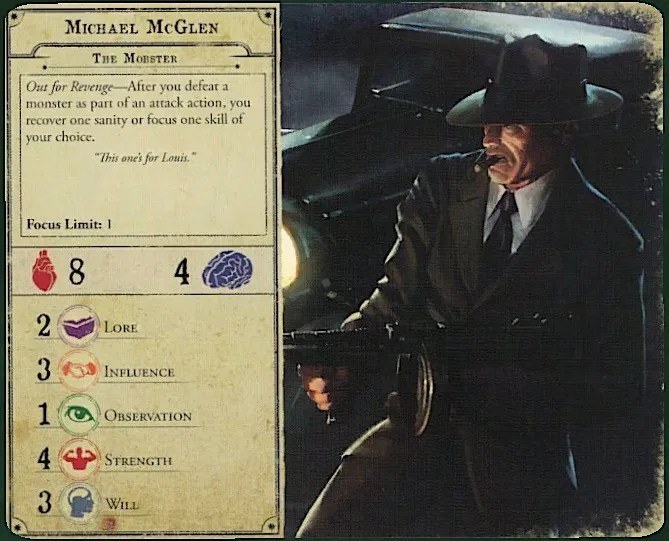
Theme – This is pretty much an expectation if you’ve played any Arkham Horror game before but the theming of Third Edition is excellent. If you’re not familiar with Arkham Horror, it is inspired by H.P. Lovecraft’s writings (and a few other authors, you can check out Reading Arkham Horror for more info on them, if you’re curious) and infuses it with a pulp setting. Organized crime, Chicago Typewriters (machine guns), and speakeasies are all par for the course here. The investigators live up to the setting as well. Many have an adventurous spirit which you would expect from a pulp setting. Michael McGlenn is a gangster, for example.
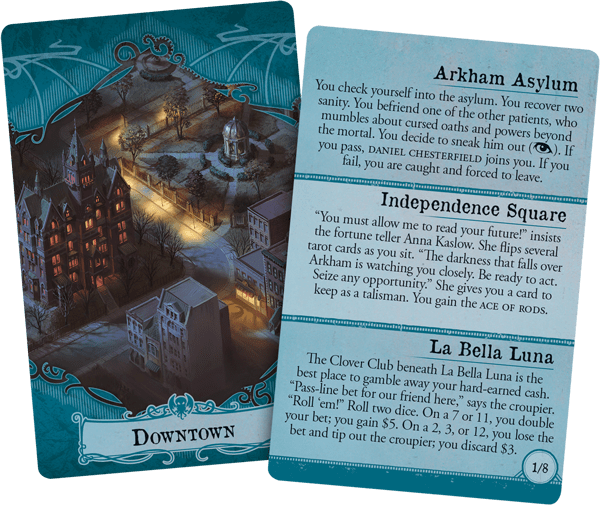
The most thematic parts of the game are the Encounter cards which vary depending on where your investigator is located. These should be familiar to anyone that’s played a previous edition of Arkham Horror or Eldritch Horror before. For example, if your investigator is located in Arkham Asylum, your character may have a chance to receive a new experimental treatment that restores their sanity. Each location offers different advantages and this is cleverly marked on the map tiles to help you figure out where you might want to go. Alternatively, if there is a clue card that is added to a neighborhood’s deck, you may have a chance to get a clue from an encounter. If things are not going so well in that neighborhood and an anomaly has spawned, then you draw an Anomaly Encounter instead. Reality warps beyond time and space in exciting and dangerous ways in anomalies which makes the results of these cards unpredictable. Generally, they help you remove doom from the neighborhood and close the anomaly so you can get back to finding clues or at least preventing doom from accumulating on the scenario sheet! Whether it is encounter cards or anomaly encounters, they’re all highly thematic and immerse you into the world of Arkham Horror.
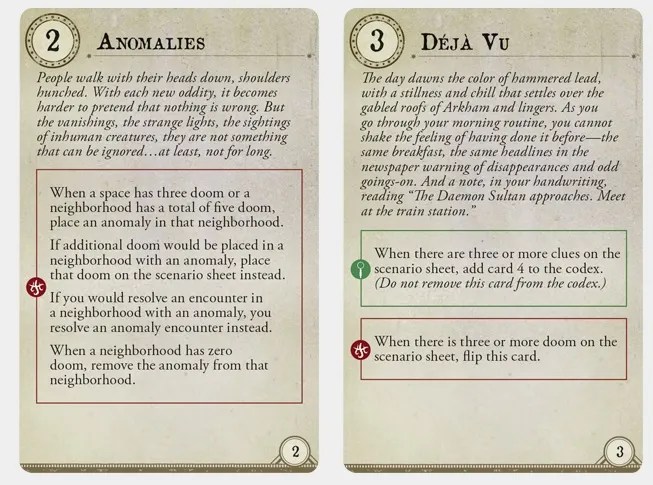
The Archive – Another great system that supports the game’s theme is the Archive. If you’ve played the Fallout board game by Fantasy Flight, then you know this system. I’ve also encountered it in Hellboy: the Board Game but neither of those games have as well thought out of a system as Third Edition. Each scenario tells you which Codex cards you start with and these explain the “rules” of the scenario and what you’re trying to accomplish. It might be obtaining and researching clues so they end up on the scenario sheet or you may have to find a point of interest or perform an action at so many locations. The Codex cards also describe how anomalies work (if they’re present in the scenario) and what next bad thing will happen if doom accumulates on the scenario sheet. As these things occur, you generally flip the card over and read the instructions on the back which bring new Codex cards (and other surprises) or inform you when you’ve won or lost the game. Its elegant and easy to operate without requiring tons of cards like Fallout did so kudos to FFG for the improvements they made to this system for Third Edition.
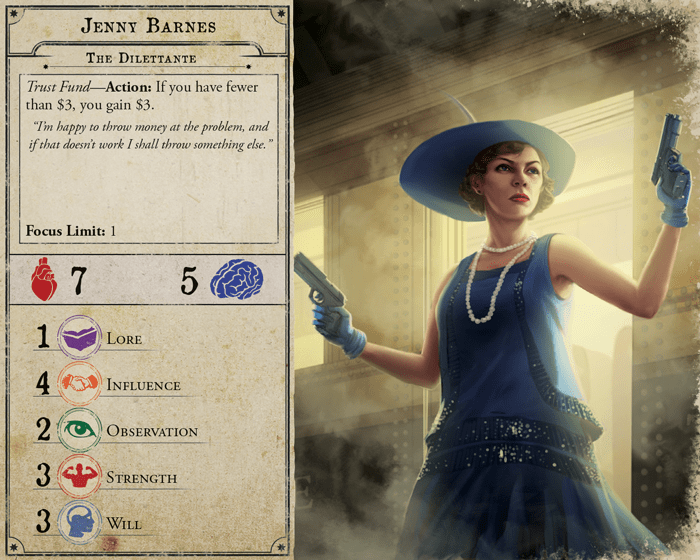
Starting Cards – There are some other really smart mechanics in Arkham Horror: Third Edition that are fun to play with. One of the first that you’ll come across is how each investigator has a choice to make when it comes to starting cards. What I like about the starting cards is that they give you a chance to tailor the investigator’s strengths. For example, Jenny Barnes is a Dilettante and she automatically starts with Searching for Izzie which lets Jenny reroll dice at the cost of 1 health and 1 sanity.
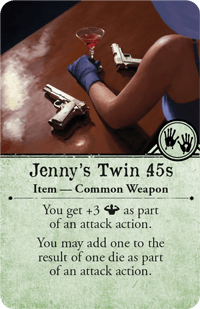
And then you get to decide between Jenny’s Twin .45s or Dressed to the Nines. The first option, her pistols, gives Jenny a pretty decent attack bonus and it lets you increase the result of one of the dice by one which can be handy as well. While this isn’t enough to make Jenny a combat powerhouse, it certainly increases her combat ability from the very beginning of the game. So if you’re looking for a dame who can take care of herself, this is a great choice.
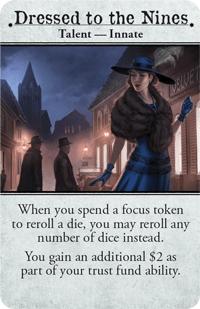
Dressed to the Nines, however, makes Jenny much more resourceful instead of being good at combat. Being able to spend a focus token and reroll any number of dice is pretty powerful and gaining extra money means she can buy more items and increase her abilities more easily as well.
So as you can see, the starting cards can really shape the investigators’ strengths and provide some variation in how they play. While I’m sure there are other board games that do something similar to this, the mechanic is new to me in Third Edition and I like how it balances strategic options for the player without adding a lot of complexity to the game. This is important for new players that haven’t come to grips with the game’s mechanics yet. It also encourages you to replay the game and try investigators with different starting cards.
Strategic Player Actions – While I will do a more in-depth comparison of Third Edition to Arkham Horror: The Card Game later on, something that I can’t help but mention now is that Third Edition gives investigators more to do overall which I think adds a little something to the gameplay. In Arkham Horror: The Card Game you generally have investigators getting clues or fighting monsters. There are support investigators too, depending on your player count, but its pretty straightforward overall.
In Arkham Horror: Third Edition, you will need characters who can fight and characters who can get clues (or possibly be good at both tasks) and you also need someone who can ward (remove doom) from the board too. Adding a third thing into the mix adds some strategic depth to the game and gives you something else to balance as well. You can’t just grab clues and fight the occasional monster or the neighborhoods and eventually the scenario sheet will fill up with doom quickly and you’ll lose. This is a cooperative game and so having three things to stay on top of fosters collaboration as well. Whenever you’re able to get into a groove and make progress on the scenario while keeping doom and monsters in check, it feels really rewarding. Sure, luck can play a role in your success and the groove never lasts as long as you want it to, but hitting that kind of “board game nirvana” is still great and its something that keeps me coming back for more.
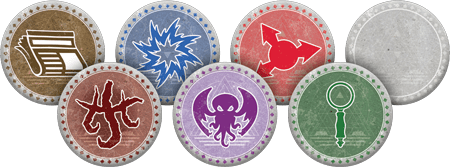
Tension and Challenge – As I just alluded to, you won’t be in the groove for extended periods of time in Arkham because the game is challenging and throws a lot of curveballs your way. Enemies move in different ways and are quite dangerous. Anomaly encounters can be good for you and remove doom but they are quite dangerous at the same time. The Mythos Phase almost always brings some kind of bad news each round. If you draw a doom token or a monster token, you’re putting doom or a monster on the board. If you draw a Newspaper headline, something bad usually happens like investigators taking damage, monsters spawning at the worst time, etc. A Gate Burst token tends to be one of the worst tokens as it places a lot of doom in a random neighborhood at once. If it happens in a neighborhood where you already have an anomaly then it really stings because all of the tokens are going straight to the scenario sheet!
Third Edition is balanced well so that the board state is frequently dangerous looking and you always have this feeling that things might spiral out of control, if you aren’t careful. This is very evocative considering the world might be ending soon in-game. Its not uncommon to have a quieter turn or two and then bad stuff happens and you feel the tension really ratchet up. When you combine the effects of the Mythos Phase with doom accumulating on the scenario sheet as your in-game “timer”, Arkham Horror: Third Edition is not lacking in challenge or tension.
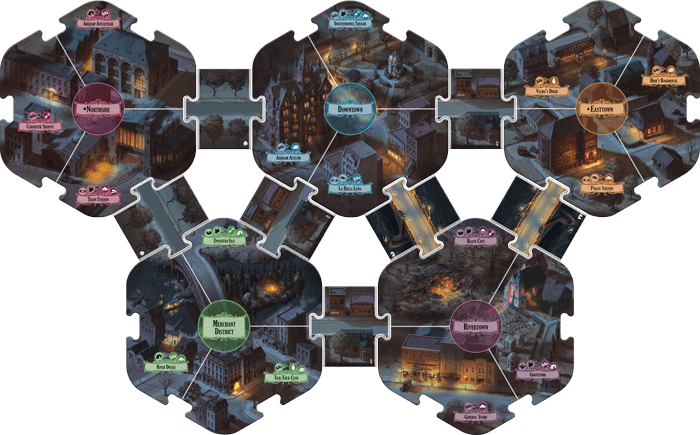
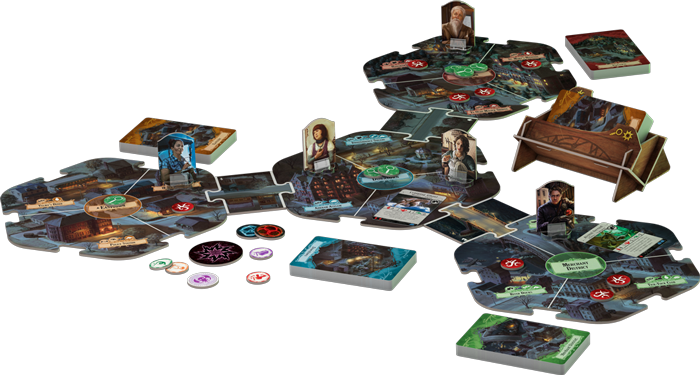
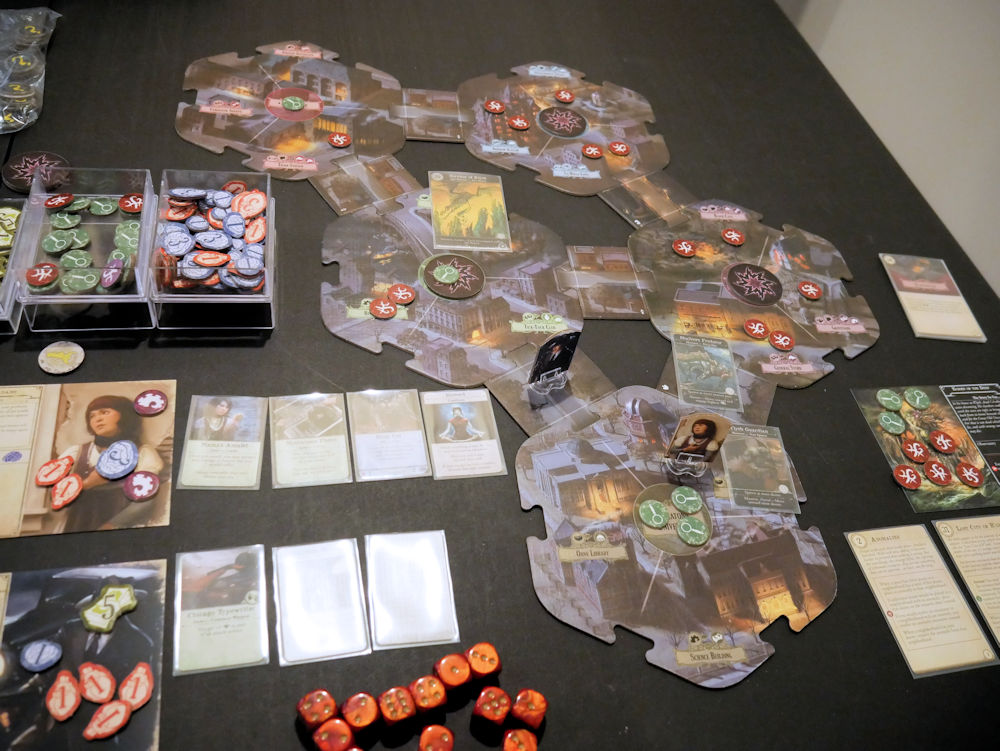
Map Variation – One thing that I haven’t discussed thus far is the map and map tiles. At the start of each game, you create the layout for Arkham based on the scenario sheet using dual sided map tiles. Each scenario has a slightly different tile layout which mixes up the locations you can visit and adds a nice bit of variety to the game. This was smart game design and an improvement on Arkham Horror: Second Edition and Eldritch Horror where the main board is static and Fantasy Flight had to add a sideboard in the expansions to create new locations which is a more static and less flexible system than what’s in Third Edition.
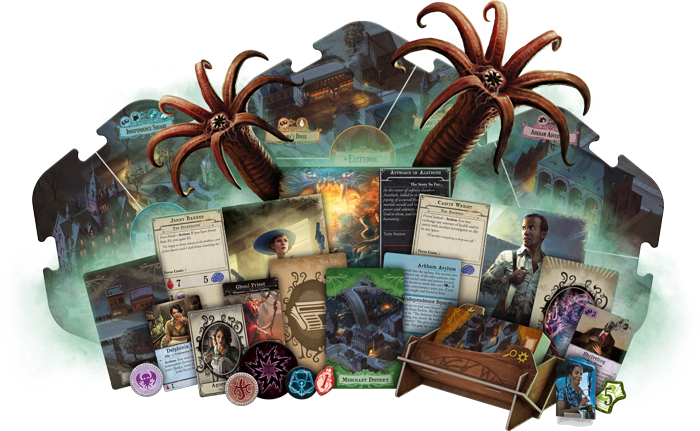
Component quality – I just mentioned the map tiles, which I think look nice and bring Arkham to life fairly well but in general, the cards, investigator standees, rulebook, and artwork are all at the quality that you expect from Fantasy Flight Games. They look and feel nice in-hand. The Learn to Play-style rulebook is concise and a great tool for learning the game. I read through it and found it really easy to jump into my first game. I don’t have rule questions very often when playing but its easy to look things up as well. If you’ve played any recent FFG games, then you know what to expect here and Arkham Horror: Third Edition will meet your expectations.
Replayability – While I have mixed feelings about the replayability, overall, I think Arkham Horror: Third Edition does a good job here. There are four scenarios to play. Two of them are not too difficult, but not too easy either. The other ones are definitely harder and took more attempts to beat. I don’t want to spoil anything but in my experience thus far, I would say that the easier scenarios are more replayable because they’re not too hard and you can try any team of investigator in the box and have a good chance of success. The harder ones will require using some of the better investigators and maybe even having some decent luck in the game to win. When you add in that scenarios tend to have three different outcomes, the designers gave some incentive for playing these scenarios multiple times. Overall, I feel like I have gotten my money’s worth out of the base game because I’ve played the game 10+ times already and had fun each time. You can certainly argue that the game could have even more replayability and it would be nice if you could use any investigator to beat the harder scenarios, but it felt to me like you need every advantage you can get in those so I gravitated towards the strongest investigators. I consider the replay value of this game to be positive overall because there are different outcomes in the scenarios and it is fun to try out different combinations of investigators as you play too. You do eventually see most of the Encounter and item cards which makes games after that slightly less interesting but all in all, I think there’s pretty good value for money and buying expansions only adds to the replayability as well.
Things I didn’t like or you may not enjoy
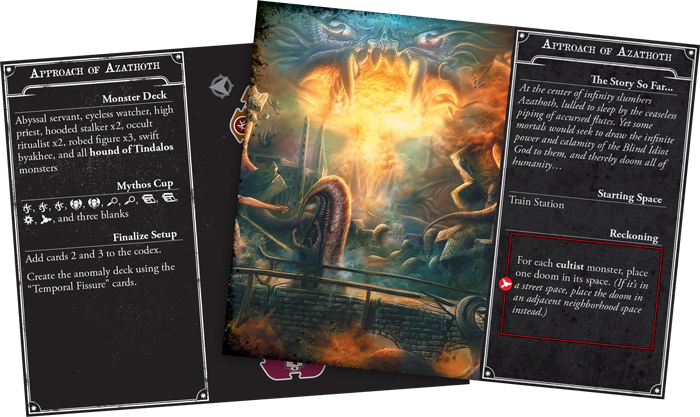
Recommended Starting Scenario – I fully admit that every review I’ve seen of this game talks about this and so I almost feel obligated to discuss it here too, but the starting scenario, The Approach of Azatoth, is one of two more difficult scenarios in the game. If you don’t play well, it ends earlier than other scenarios too. It is a mystery why FFG suggested new players start with this scenario and while I followed their advice and quickly lost. It didn’t dampen my enthusiasm for the game at all. If anything, I was excited to try an easier scenario afterward because I knew ahead of time that Azatoth would be tough. So if you do follow their recommendation, just know that its a difficult scenario and that its not a bad idea to switch to an easier one like Veil of Twilight or Feast of Umordoth, which are more forgiving afterwards.
Action Phase’s Quickness – While of course, you want to think before you act and make sound decisions while playing any game, your Action Phase goes by so fast in this game compared to everything else. The Action Phase is the only time the investigators get to do anything and its pretty common to want or need to move, so the two actions you get per round are over before you know it! As I will discuss in more detail shortly, one of the common criticisms of this game is that you don’t get to do a lot and you spend a lot of your turn watching other things happen during the game “administration”. I think this feeling is definitely made worse by how fast this Phase always goes and because you’re always left wanting. You always wish you could do one more thing and improve your “board state” and you very rarely will be able to do so. Its funny because this in some ways a good thing and there are times where I like how the game leaves you wanting but I can see where some people may find it frustrating and wanting to do more is something you’ll feel often when playing. I would say I feel this way a couple times a game at minimum. So just know that this is part of the game and something you will cope with. I embrace it and don’t mind it but I think some people out there do not enjoy this part of the game.
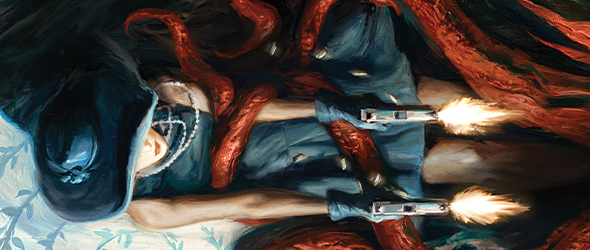
Only One Action Type Per Turn? – One of the easiest rules to forget in Arkham Horror: Third Edition is the limitation on actions. You can only perform one action per turn with a few rare exceptions. This means you can’t move twice and cover a lot of ground in Arkham. The board might be swamped with enemies and yet, you can only fight and potentially kill one monster a turn most of the time. This limitation does feel a little artificial and it increases the overall challenge for no real player benefit. Of all the things I’m going to talk about in this section, this is the one I like the least and I wish the designers had found another way to balance things. There are often times where I really wish I could do something twice when I need to and its a shame its not permitted. There are also times where I feel forced to take an action like getting a focus token or earning money, when I’d really rather be doing something else that is more impactful but I don’t have a choice. For me, this is a minor complaint overall but it is an area where I think the design of the game could have been improved and player choice could have been maximized.
Too much admin and not enough playing? – The most common complaint I see online is that many people feel that the balance of time spent doing something versus administering the game is not even enough. I already touched upon how fast the Action Phase goes but the remaining phases minimize player choice while other things go on. In the Monster Phase, monsters move and attack you, if they can. In the Encounter phase, you do get to draw a card and have an encounter but at most, you’re testing a skill and getting a benefit or suffering some kind of negative effect. There isn’t much strategy or agency there other than when you decide where to end your last movement. The Mythos phase requires each investigator to draw tokens out of a cup or hat and then whatever they pull is resolved. Again, not a lot of choice or agency. Each of these Phases play an important role in the game and the Mythos and Monster Phase can both be pretty intense depending on what is going on and how lucky you are at drawing tokens. So I wouldn’t say the phases are boring, even when you’re not doing things as the investigator, but I do sort of understand why people wish they could do more and watch things happen less. I can’t say I’ve ever played a game like Third Edition where it is this imbalanced but I don’t find the amount of administration required to play the game off-putting at all. It makes me appreciate the actions I do have in the Action Phase that much more. Of course, your mileage may vary, especially in light of how common this complaint is levied against Third Edition. It clearly bothers some people out there and fair enough, I think that’s a totally valid criticism.
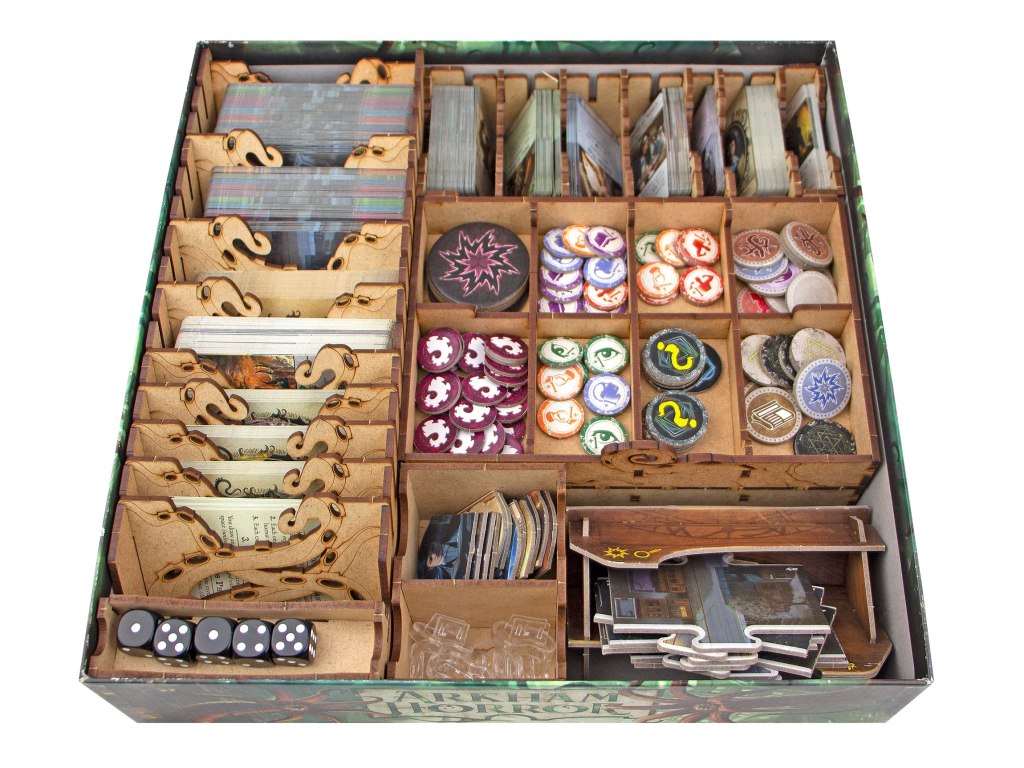
Setup is on the longer side – While I wouldn’t say that setup takes 30 minutes, it certainly takes more than five minutes. As is always the case with FFG games, they provide minimal organization in their boxes which partially contributes to the long setup time. There are a lot of card decks to grab and shuffle, the map needs to be assembled, and tokens need to be sorted and distributed. If you like the game and choose to invest in organizational items, that will speed up the setup time quite a bit. There are still quite a lot of cards to shuffle up and you have to gather some specific cards for whichever scenario you’re playing, but that is still much quicker than how long it takes without any organizational items. So you have some control over and while it does take some money to solve the problem, if you enjoy the gameplay then its money well spent.
Three to four hours gametime – For me personally, I prefer a game that is two hours or less. In fact, I’m guessing that most of the board and card games I’ve owned fall into the two hours or less variety other than Arkham Horror: Second Edition and Third Edition. Before I actually played Third Edition, I was hesitant to try it because of the playtime. However, after trying the game, I’m happy to say that the longer gametime is not as much of a problem as I feared. I got used to it fairly quickly and I usually break up the game by playing it over the span of two or three sessions which could be over a day or two or three. It is surprisingly easy to set the game aside and pick it back up the next day, if you have the luxury of table space. Would I prefer a shorter game time? Absolutely! At the same time, I think that might take away from the scale of the game and limit what scenarios can do which is not something I would particularly want. So if you’re somebody who hasn’t played longer board games before, don’t let that necessarily put you off a game like this. I adapted to the longer gametime much better than I expected and I don’t mind the game length which has been a pleasant surprise.
Why Arkham Horror: Third Edition is great for fans of Arkham Horror: The Card Game
While writing this article, my plan was to discuss how Third Edition compares to several other Arkham Horror games I’ve played but I realized how long it would make this article and that in all honesty, just talking about it compared to the LCG is more than enough.

Prior to playing Third Edition, I played Arkham Horror: The Card Game and really liked it. I didn’t play through all of the content that was released even a few years ago but I liked everything I did play. The problem I ran into was that I struggled to balance my other hobbies: painting miniatures and playing video games with the LCG. Because the game is campaign based, I found it difficult to find the time to play through an entire campaign and not feel like I was neglecting one of my other interests. It doesn’t help that a campaign can take 15-20 hours to complete and once I started, I didn’t want to take too many breaks or I’d lose momentum with the story. Ultimately, I felt like I didn’t have the time to achieve what I wanted in the Card Game and so I got rid of my copy. It wasn’t because I didn’t love the game, I just wasn’t able to play the long campaigns in the way I wanted to. Truthfully, I’ve missed Arkham Horror since I stopped playing the Card Game and that was definitely a factor in why I decided to try Third Edition.
Since starting Third Edition, I’ve found that it not only scratches a similar thematic itch but it is a great alternative for anyone who is either looking for a less time intensive game or they don’t like the direction the card game is going currently. Like I already discussed, Arkham Horror: Third Edition is not a campaign based game and it takes around 3-4 hours to play. This is much easier to find time for than a campaign that runs 15-20 hours. While I do miss being able to play for 1.5-2 hours at a time as that is my gaming sweet spot, I find Third Edition much easier to actually play and it doesn’t cause me stress like the Card Game started to towards the end.
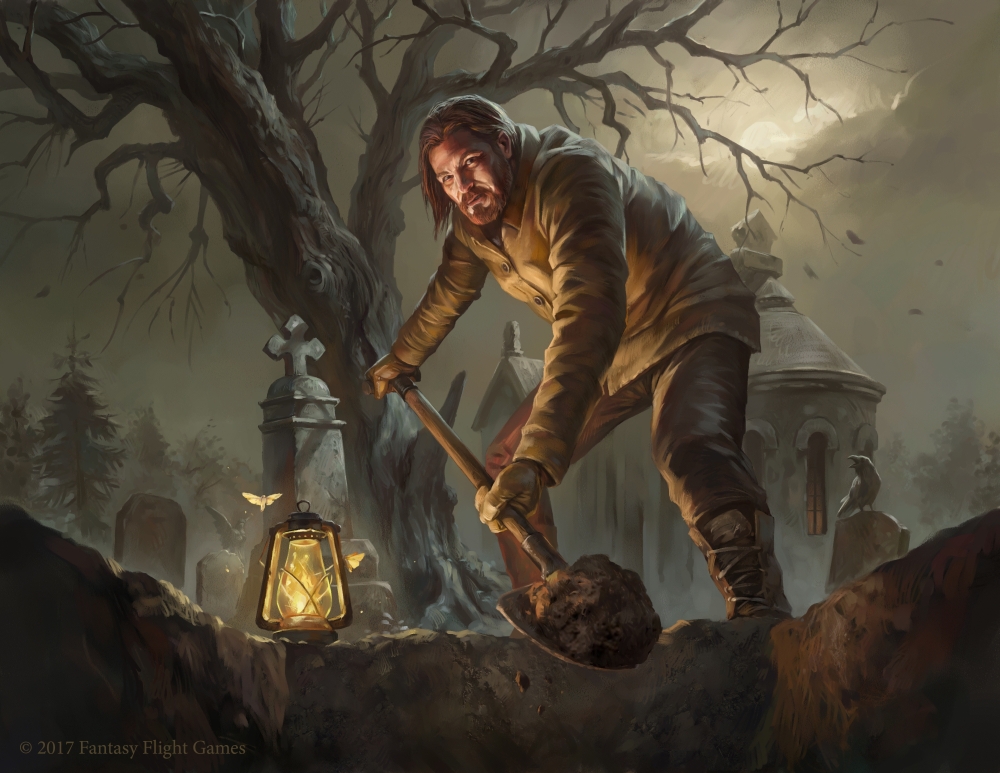
One of my least favorite things about the Card Game is how it handles investigator deaths and I’ve been thrilled with the way Third Edition treats it. As I just mentioned, the LCG has a heavy campaign emphasis and that is in fact the only way I played it (you can play one-off scenarios but I don’t think its especially popular). To play Arkham Horror: The Card Game, you have to build your investigator deck(s) which takes some time and prep work. Indeed, gamers who are not used to playing LCGs or CCGs (competitive card games like Magic and Pokemon cards, among many others) often complain about having to deckbuild. I love that part of Arkham Horror: The Card Game but I know that many people do not. And this alone is a reason to consider Third Edition over The Card Game. Getting to pick your investigator and their starting cards gives you some choice and flexibility but requires no deck building which seems like a great balance for many board gamers.
For me, the thing I found most deflating is when I built a deck for an investigator in the Card Game, played a couple scenarios, got experience and upgraded cards and was excited about developing the deck further and then the character sadly dies. The rules for the game state you should pick a new investigator, build them a deck, and continue you on. I never liked this rule even though I understand why FFG did it. Having to jettison whatever deck you put a lot of effort into was always really deflating. It made me feel bad for letting the investigator die and I was always invested in whatever I chose to use and then suddenly, I had to pivot to using someone else with what was generally a weaker deck. A lot of the time, I would just restart the entire campaign with a different deck altogether instead of picking a new investigator because that just felt better to me for whatever reason.
In Arkham Horror: Third Edition, if an investigator dies, you put one doom on the scenario sheet and pick a new investigator and their starting items. While you can potentially lose valuable clues and items when this happens, I find this MUCH less deflating and more enjoyable of a setback. I’m sure it helps that I’ve been playing for less game time and have less invested in the investigator, but regardless, this is one area where I think Third Edition shines compared to the Card Game.
I probably could have started with this reason but if you have played the Card Game, you will find many elements of Arkham Horror: Third edition to be familiar. I’m sure part of the similarities between the two games is because they were designed around the same time but regardless, it works out very nicely for fans that want to jump between the two games. Many mechanics and cards work similarly in the two games and so picking up one game after you’ve played the other could not be easier. Even the investigators tend to serve in similar roles between the two games. Some investigators are great fighters, others are great at surviving, and others are effective clue finders. Of course, its neat seeing familiar characters like the investigators themselves and even NPCs like Lita Chandler, but I really can’t understate how at home you will be with Third Edition, if you’ve played the LCG before. For me, there was a couple years in between playing the two games and it felt like reuniting with an old friend.
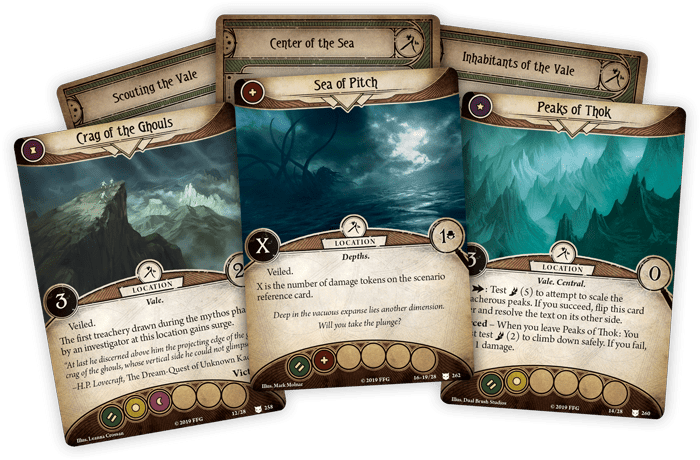
Along the same lines, I think the thematic elements of the card game are also present in Third Edition. There are some things I miss like how each scenario in the Card Game has its own unique map made up by cards in the deck. At the same time, I think the scenarios and encounters from the board game are pretty equitable to the card game’s theme overall. Both have you doing things that feel thematic and there are highly thematic cards you get to use too. Dynamite and Dynamite Blast, for example, does five damage to all enemies you’re in combat with in both games, for example! There are many examples of this overlap, far too many for me to list, so you’ll just have to take my word when I say that its easy to jump between the two games.
Lastly, Arkham Horror: Third Edition has way less content released for it than the Card Game. Obviously, if you’re someone who has ever felt overwhelmed or like they couldn’t keep up with the pace of releases in Arkham Horror: The Card Game, this is going to be appealing. That is something I unfortunately struggled with and while I love FFG’s expansion support for their games, it can be expensive and its certainly time consuming to play and replay it all as much as you want. While many Third Edition fans wish we had even more content released for the game, it is a good amount and its far from overwhelming. There’s only three expansions and they cost a little over $100 to acquire them all so not too big of a lift compared to the Card Game. You may actually get through all of the board game’s content whereas the Card Game is much harder to accomplish the same feat. This is truly a case where less can be more if you’re a person with multiple hobbies or have limited free time.
Final Thoughts
While I can’t say that Arkham Horror: Third Edition is perfect or even my favorite game ever, I do think its a really solid entry in the series and I actually like it better than Second Edition overall, which I know is a hot take. Third Edition is a game that is friendly to new players and has quite a bit of streamlining in the rules. There are some flaws to the game but I find them pretty easy to ignore because there are so many enjoyable parts that balance them out. While it might seem counter-intuitive with the longer gametime compared to Arkham Horror: The Card Game, overall, Third Edition takes less time to play and is friendlier to casual players and anybody who does not want to deckbuild. Perhaps most importantly, the content comes from what might now be considered a golden period at Fantasy Flight Games. In recent years, the company’s productivity has really dropped and they mostly work on their existing Living Card Games instead of board games. They’ve recently tinkered with Arkham Horror: The Card Game in ways that do not seem very popular with the existing player base and even the artwork on the most recent cards have been a little off compared to the stellar work done in the past. All this is to say, if you are disgruntled with the LCG but looking to stay in Arkham, Third Edition is well worth a look. I’m really glad that I found it and I see it staying in my collection for many years to come.


Wow, that’s one hell of an in-depth write-up! We’ve got the card game, but never gotten around to playing it. I have to say the whole deck-building aspect is something I find off-putting as well since I never played games like MTG and so never really “got” the concept properly. I do wonder why FFH used the exact same name for both a board game and a card game. I guess they feel like the people really invested will play both and anyone who buys a wrong box can be damned and hopefully just try the other game.
Unfortunately, I haven’t had much time for board games in the past year (*or two?) – even the ones I really enjoy already so something like this, despite the positive review isn’t something I can see myself picking up. Still an enjoyable read and please do continue to review your game collection!
LikeLiked by 2 people
I wrote it in a number of sittings but even last night as I was trying to finish it, I was a little “winded” from the ordeal (though it was also Friday night so take that for what its worth) 🙂
I totally get how you feel about deck building and I think the people who don’t want to build decks come from a similar mindset/experience level. The tricky thing about Arkham Horror: The Card Game is you build the deck AND make small upgrades as you play through the campaign. That is a bridge too far for people not interested in building decks. Having said that, you can easily find deck lists with upgrade suggestions online so its easy to get around the deck building, if you want. Finding the time to play a full campaign is arguably the bigger challenge!
And yes, the naming is confusing and its kind of a pain to try differentiate them in this review. I would have preferred names that are easier to tell apart too.
I know you have plenty on your plate gaming wise so I totally understand it. I’ll review the rest of the expansions for this one as I get around to it. I had every intent of reviewing Hellboy one day but I’m skeptical I ever will because its kind of a pain to explain the differences between retail and Kickstarter alone. I can only speak to what the Kickstarter version is like as that is what I own too. Either way, thanks for giving this novel of a review a look! 🙂
LikeLike
Excellent in depth review Jeff, I like how you cover all the details both positive and negative, and your rational explanations as well.
LikeLiked by 1 person
Thanks, Dave! It is quite an endeavor to write but I appreciate detailed reviews (when there’s plenty to discuss) and so I tried to give a balanced look at this game.
LikeLiked by 1 person
Amazing work! I don’t think my review of the game was anywhere near so comprehensive, bravo! I think you’re actually tempting me back into this, the way I’ve been trying to get Hellboy to the table to tempt you 🤣
I think it’s a fantastic game, the setup time usually exhausts me (I timed it once at 45 minutes!) but it’s remarkable at just how well the rhythm of the game keeps it moving so very well. I really need to remind myself of that.
Interesting you mention how difficult the Azathoth scenario is. I don’t know if it’s the actual reason for it, but I always thought it was interesting how, if the scenario is going badly, then you’re not stuck in this cycle of things getting worse and worse, but it’s just over and done. So new players don’t have the feeling that the game is just grinding you down, and hopefully it’s over quick enough that they might want to play it again? I could be going up the wrong tree, but I thought it was a nice way to design the introductory scenario!
One of the things you mentioned got me thinking – character death. I don’t think you’ve played Eldritch Horror? The way that game handles it is superb, and I was surprised it wasn’t ported over here in some way, as they share a designer. I can definitely recommend that game, anyway!!
Also, and this might just be because I’ve mixed the expansion in, but there are cards that give you more actions, but they may have been in Dead of Night. That’s possibly the single best thing you can buy after the core set, as it’s just ‘more of the same’ but with a bootlegger scenario 😃
LikeLiked by 1 person
Thank you, mate! I was motivated by the fact that the game is a bit underrated or at least underappreciated currently. And don’t worry about that with Hellboy. I’ve already been wanting to play for a while now, I just have to stay patient and keep painting 🙂
You make a great point about Azathoth. You definitely don’t have the Echoes of the Deep problem where two different big monsters hit the board and it kind of feels hopeless to kill them if you’re behind schedule. You watch the game get away from you over time and there’s nothing really you can do about it. That could very well be the logic of starting with that scenario though I still think the two easy scenarios would have made better starting points, not that it put either of us from the game 🙂
While I kind of want to get back into Arkham Horror: The Card Game, I’m leaning more towards getting Eldritch. People love that game and generally prefer it to this one so it sounds worth trying to me!
There is at least one card in the base game that gives an extra action. I think its a stopwatch of some kind. Marie Lambeau is really good with extra actions too. I’ve barely used her but I could immediately see her power as a support character. I’m really excited to play Dead of Night. My plan is to mix the encounter cards and investigators in the base game and play it a bit to see how it changes the game and then I’ll try the rest of the Dead of Night content. That should make it easy for me to review that expansion in the future 🙂
LikeLiked by 1 person
I always thought it was interesting how the board game almost sought to reimplement the card game in the way the investigators belong to classes, like the Guardians and Survivors etc, and got to have starting cards. It even included the Night of the Zealot campaign as a scenario, which I 100% loved.
However, given where the LCG is right now, I think Eldritch Horror is a great idea. Amazingly, I’ve just checked Amazon.com and it’s surprisingly very much still available! For a game of its vintage, I’m really surprised!
If you want to check out my 12 year old review of the core set: https://spalanz.com/2014/05/06/the-horror/
😃
LikeLiked by 1 person
Yes, it was kind of an interesting strategy. Maybe they hoped the two games would feed off each other sales wise since they’re similar? I liked that detail too. Arkham Horror as a whole really uses cameos and repeated content well like that. It almost always feels cool to see a familiar face or location.
Yes, I was shocked that Eldritch is widely in print. It must be a good seller for FFG for them to keep it around so long. I’m thankful for it as I suspect I’m going to want more Arkham than just Third Edition can provide 🙂 I shall give your review a look right now!
LikeLiked by 1 person
Thanks for the very detailed review! Very interesting read, really liked those thoughts on why this works better for you than the card game.
I like the look of that modular board, very practical from an expansion point of view. I wonder if we’re going to see more games adopt that.
LikeLiked by 1 person
Thanks, Nic! I was a little surprised that it has replaced the card game for me as I wasn’t sure that was possible. I agree on the modular board idea. Dungeon crawlers do it and I see no reason why other games can’t do the same! Having pieces lock together helps keep them from moving around too which is a nice bonus.
LikeLiked by 1 person